November 3, 2026

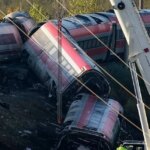
On Monday, the Spanish authorities announced the identification of all the victims of the disaster of the two high-speed train collision, which occurred last Wednesday about 150 kilometers south of the capital, Madrid, and resulted in the deaths of 69 people.
The investigation team, which includes police officers and forensic experts, confirmed that the death toll includes 54 Spanish citizens and 15 foreigners. The list of foreign victims includes: 4 Americans, 2 Australians, and 2 Japanese, in addition to one citizen each from Argentina, Canada, France, Mexico, Portugal, Czechia, and Tunisia.
In a related context, intensive investigations are continuing to uncover the circumstances of the disaster, as preliminary data leave the door open to the hypothesis of “human error.” The Spanish Minister of Transport, Oscar Puente, explained that the chronology of the accident began with a malfunction in an information system that led to the cessation of the movement of a number of trains.
According to a preliminary memorandum issued by the independent administrative body charged with investigating train accidents, shortly after the breakdown, “wrong instructions” were issued by the control center, which ruled that one of the “Renfei” trains be allowed to resume its journey. This led to him violently colliding with another stationary train, at a speed estimated at between 160 and 200 kilometers per hour.
The ongoing investigations seek to precisely determine who is responsible, and to find out whether a technical defect alone is responsible for the tragic series of events, or whether wrong human decisions played a role in the disaster.
This tragedy reopens the file of railway safety in Spain to the forefront, as it is the second train collision accident the country has witnessed in less than a year, after a similar accident that occurred last January and claimed the lives of 46 people.