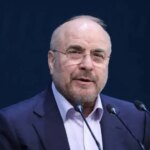
The Speaker of the Iranian Parliament, Mohammad Bagher Qalibaf, escalated the tone of his rhetoric towards the United States, stressing that any aggression or adventure against his country will be met with a “firm, painful, precise, and swift” response, sending a challenging message to Washington by saying: “Try to receive our response.”
In his speech during the public session of the Shura Council, Ghalibaf stressed that White House leaders must realize that Iran will never retreat under the weight of threats or siege. He warned of a new security equation that says, “If Iran cannot sell its oil, no one will be able to sell oil in the region,” threatening that if Tehran’s security is not ensured, “no infrastructure will be safe.”
Qalibaf touched on the role of the former Secretary-General of Hezbollah, describing him as “Mr. Martyr Hassan Nasrallah,” as he was a strategic leader who changed the balance of power in favor of the oppressed, and made Hezbollah a deterrent force that reformulated regional security equations. He stressed that the party continues its march with the same discipline and vision, considering that the enemy’s belief that eliminating the leaders will stop the resistance in Lebanon has proven its failure over the past two years, as the enemy has become trapped in a dead end thanks to the tight resistance structure.
Regarding America, Qalibaf considered US President Donald Trump’s statements regarding the Strait of Hormuz and the passage of ships “a repetition of exposed allegations.” He believed that Trump’s threats at the United Nations General Assembly reflect the lack of change in American behavior, stressing that “the era of intimidation and threats to destroy Iran’s civilization has passed.”
This comes at a time when Trump expects to hold a new round of talks with Iran this week, after he rejected a previous Iranian proposal for a settlement that he described as “unacceptable,” in light of the continuation of indirect contacts through mediators to reach a settlement formula and reopen the Strait of Hormuz.
Iran had presented to Washington, through Qatar and on the sidelines of the United Nations General Assembly meetings, a 7-day settlement plan conditional on accepting Iranian conditions, with the Strait of Hormuz opening on the sixth day and negotiations resuming on the seventh day, to address the fighting and reopen the Strait.
In the same context, the spokesman for the Islamic Revolutionary Guard Corps, Brigadier General Hussein Mohebi, confirmed that Iranian forces will not stop punishing the United States until the seven Iranian conditions are fully implemented.
Media and international reports indicate that the Iranian plan includes releasing frozen assets worth about $12 billion, lifting sanctions on Iranian oil, ending the US naval blockade of Iranian ports, in addition to stopping hostilities in the Middle East, including Lebanon, and resuming nuclear negotiations, as these items, along with opening the Strait of Hormuz, are at the heart of the ongoing negotiations.