Secret intelligence documents sent to the US Congress revealed that intelligence agencies estimate that Saudi Arabia has not ruled out the option of developing a nuclear weapons program. This assessment raised growing concerns among Democratic lawmakers about an agreement concluded by the administration of President Donald Trump to help the Kingdom establish a civilian nuclear program.
According to a report prepared by journalist John Hudson in the Washington Post, the agreement allows American companies to launch nuclear energy projects in Saudi Arabia worth tens of billions of dollars. The Trump administration hopes that this cooperation will strengthen bilateral relations and prevent Riyadh from resorting to China or Russia, stressing when announcing the agreement last July that it will support the security of the United States and the region in accordance with strict standards of safety and non-proliferation.
On the other hand, Democratic objections in Congress are mounting during a 90-day review period during which lawmakers can attempt to stop the agreement legislatively. The main concern centers on a possible path that would allow Saudi Arabia to enrich uranium locally to a level of approximately 20%, and the possibility of converting nuclear materials for military purposes.
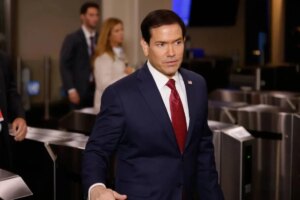
Senators, led by Ed Markey and Jeff Merkley, sent a letter to Secretary of State Marco Rubio in which they accused the administration of abandoning its previous approach and accepting less stringent restrictions that would give Riyadh the means to enrich and possibly develop a nuclear weapon. On the other hand, American officials reported that the State Department provided an assessment in secret documents that seemed more confident in American guarantees and Saudi reassurances. However, Senator Merkley refused to be satisfied with that, questioning why Riyadh adhered to local enrichment and reprocessing and refused broad inspection by the International Atomic Energy Agency if it denied its military intentions.
The Saudi government did not respond directly to the newspaper’s questions, limiting itself to referring to a previous statement by the Minister of Energy, Prince Abdulaziz bin Salman, in which he affirmed the program’s peacefulness and transparency. For its part, the US State Department stressed that it “does not and will not support a Saudi nuclear weapons program,” considering that the agreement adopts a realistic approach that balances expanding cooperation with non-proliferation standards, while the Central Intelligence Agency (CIA) refrained from commenting.
The agreement stipulates keeping Saudi uranium enrichment in its first stage below 5%, with the possibility of raising the ceiling to 20% later after additional study and a written agreement. Opponents warn that uranium enriched to 20% could be quickly upgraded to weapons-grade levels, comparing that to the Trump administration’s strong criticism of the 2015 Iranian nuclear deal that capped Iranian enrichment at 3.67%.
The agreement also faces criticism related to oversight minorities, as it does not oblige Saudi Arabia to join the “Additional Protocol,” which gives the international agency broad powers to access facilities. In this context, 20 non-proliferation experts, including former Director General of the Agency Hans Blix, sent a letter to Congress in which they considered the absence of this commitment unacceptable for a country that seeks to possess the capabilities to produce fissile material and has previously brandished a nuclear weapon.
Experts recalled a previous statement by Saudi Crown Prince Mohammed bin Salman in 2018 in which he affirmed that the Kingdom would follow Iran’s example as soon as possible if the latter developed a nuclear bomb. With continued regional tension and the tightening of Iranian leadership following this year’s war and the assassination of the Supreme Leader, fears are increasing about the acceleration of the regional nuclear arms race, as Senator Markey warned that any American step may exacerbate this race.
In the internal context, some Democratic representatives praised the frankness of the intelligence assessment, despite the pressure previously exerted by the administration on intelligence officials. Representative Brad Sherman believed that “the last people to tell the truth” within the agencies could hardly withstand these pressures.
For their part, supporters of the agreement defend it as an opportunity for American companies to win major contracts and exclude Chinese and Russian competitors. However, Democrats raised questions about the potential beneficiaries, pointing to an investment worth two billion dollars that Jared Kushner received from the Saudi Public Investment Fund after leaving the White House, as well as potential contracts for companies linked to prominent names, at a time when the relevant authorities did not respond to requests for comment.
Democratic lawmakers, including Representative Gregory Meeks, are seeking to introduce legislation to reject the agreement during the review period, despite President Trump’s ability to use his veto unless the project receives a two-thirds majority of votes.
In addition, another political obstacle arises, which is Trump’s insistence on linking the completion of the agreement to the normalization of relations between Saudi Arabia and Israel. While a senior official confirmed the administration’s adherence to this condition, analysts believe that Riyadh will not advance normalization in light of the Israeli government’s rejection of the establishment of a Palestinian state, leaving the future of the agreement suspended between fears of nuclear proliferation and complex political obstacles.