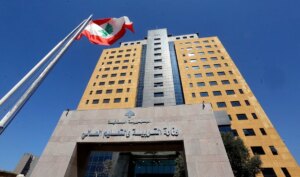
On Thursday, the US Embassy in Beirut welcomed the Lebanese Parliament’s approval of the Bank Restructuring Law, calling on the government to move quickly to complete the reform path by approving the Financial Gap Law, in an American position linking the two legislations as an essential part of addressing the repercussions of the financial collapse that has continued since 2019.
The embassy said, in a statement published on the “X” platform, that the United States “welcomes the Lebanese Parliament’s approval of the bank restructuring law in Lebanon, and strongly urges the Lebanese government to continue its efforts to pass the financial gap law.”
She considered that these two legislative measures represent “decisive steps towards strengthening Lebanese state institutions, restoring confidence in the financial sector, and advancing sustainable economic recovery.”
The embassy affirmed that the United States remains “firmly committed to supporting meaningful, transparent, and accountable reforms that will enhance the long-term stability and prosperity of the Lebanese people.”
The American position comes on the same day that the International Monetary Fund welcomed the amendments approved by the House of Representatives to the Banking Reform and Reorganization Law, describing it as a “big step” in the direction of addressing the financial crisis, while stressing that the actual implementation of the law will be essential.
The amended law grants the Supreme Banking Authority broader powers to decide the fate of troubled banks, including determining whether the bank needs to be restructured or liquidated, and setting the necessary procedures for its rehabilitation, as part of an attempt to find a legal mechanism to address the conditions of the sector that has been experiencing a deep crisis since the collapse of the financial system in late 2019.
But the bank restructuring law alone does not resolve the most sensitive issue for the Lebanese, which is how to distribute financial losses and determine the responsibility of the state, the Bank of Lebanon, and the banks, in addition to the mechanism through which depositors will recover their money.
Here the importance of what is known as the “Financial Gap Law” emerges, which officially bears the title of the Financial Regularity and Deposit Recovery Law, and aims to establish a framework for addressing the accumulated losses in the financial system, determining how to recover deposits, and arranging responsibilities among the various parties.
The IMF announced that discussions with the Lebanese authorities are still ongoing regarding required amendments to the draft financial stability and deposit recovery law, with the aim of making it compatible with international principles and standards, especially in terms of protecting depositors, the hierarchy of creditors, and how to distribute losses.
Estimates of losses set by the Lebanese government in 2022 amount to about $70 billion, while economists believe that the number may have increased since then, which makes determining how to distribute these losses one of the most complex and contentious issues between the state, banks, and depositors.
The roots of the crisis go back to late 2019, when banks imposed harsh restrictions on withdrawals and transfers and practically prevented depositors from free access to their accounts in dollars, coinciding with the collapse of the lira and the state’s cessation of paying its foreign debts. Since then, addressing banking losses and recovering deposits has remained without a comprehensive solution.
The basic law to reform the status of banks was issued in August 2025, before the Constitutional Council later invalidated some of its articles, which necessitated introducing new amendments during the current year and re-discussing the text in the Finance and Budget Committee and then in the General Assembly of the House of Representatives.
During the discussion of the amendments, the Chairman of the Finance and Budget Committee, Representative Ibrahim Kanaan, stressed the need to prevent overlapping of powers between the various regulatory bodies, and to clarify the role of the Supreme Banking Authority in restructuring and liquidation, in parallel with the demand to address the deposit file within an independent law that secures financing and rights after auditing the assets of the state and banks.
The entry into force of the amendments is still linked to the completion of constitutional procedures, as the IMF indicated that the law approved by the Council requires the approval of the President of the Republic, Joseph Aoun, and the possibility of appealing it before the Constitutional Council remains.
The position of the American embassy, after the position of the International Monetary Fund, reflects a clear international consensus on the necessity of completing financial legislation and not being satisfied with restructuring banks alone.
The goal for international bodies is not only to identify viable banks and those that must be liquidated, but also to reach a clear and transparent formula that determines the fate of tens of billions of dollars in losses, protects the rights of depositors and rebuilds a banking sector capable of lending and financing the economy.
Hence, the US Embassy’s call to approve the Financial Gap Law carries a direct message to the Lebanese government that approving the Banking Law is seen as an essential step, but it is not the end of the path.
The most sensitive test will remain in the law, which will practically determine who bears the losses, how deposits will be returned, and on what timetable, and whether Lebanon will finally be able, after nearly 7 years of crisis, to establish a comprehensive framework that will restore confidence to the banking sector and open the way for a broader reform agreement with the International Monetary Fund.