November 21, 2026

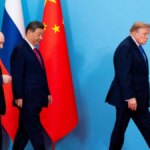
The unprecedented tripartite summit that brought together US President Donald Trump, Chinese President Xi Jinping, and Russian President Vladimir Putin in the Chinese city of Shenzhen raised deep concerns in the Japanese government about the possibility of this meeting turning into a permanent framework for coordination between the major powers, affecting the international system and Tokyo’s strategic position.
Following the summit on Thursday, Japanese Prime Minister Sanae Takaichi quickly made a phone call to Trump, during which she stressed the importance of continuing close cooperation between Tokyo and Washington. In the same context, Japanese Chief Cabinet Secretary, Minoru Kihara, stressed during a press conference in Tokyo on Friday that his country will continue to coordinate with its allies and partners to maintain and strengthen a free and open international system, while adhering to the principle of the rule of law.
The leaders of the three countries issued a joint declaration of peace, in which they affirmed their commitment to maintaining strategic stability and international security. Although no major decisions were issued from the meeting, which raised relative relief among Japanese officials, concern still exists about the possibility of the tripartite meetings turning into periodic summits. Media reports quoted a Japanese government official as saying that Tokyo breathed a sigh of relief for not making fateful decisions, while a senior Foreign Ministry official believed that the future of this framework “depends entirely on how serious Trump is about the tripartite partnership.”
In parallel, the historical references evoked by the summit aroused great interest in Tokyo. Chinese President Xi Jinping touched on the three countries fighting side by side against fascism, considering that the common victory united them. This is a proposal supported by President Putin, and similar to what Trump stated last September regarding the alliance of the two countries during World War II. Commenting on this, a senior Japanese government official said: “We cannot ignore the fact that China and Russia are stirring up these ties.”
Japanese concerns were not limited to the future of coordination between the major powers, as the International Criminal Court file emerged as a potential point of contention between Tokyo and Washington. The Joint Peace Declaration included a warning that the International Criminal Court and its similar bodies “must not abuse their jurisdiction.” This item gains sensitivity in light of the court (headed by Japanese Tomoko Akane, based in The Hague) issuing an arrest warrant against Putin against the backdrop of the invasion of Ukraine, as well as investigations into allegations that the US army committed war crimes, while Japan insists on supporting the court.
After her call with Trump, Takaichi acknowledged to reporters that there was a difference in views between Tokyo and Washington regarding this issue, but she stressed her country’s commitment to the rule of law. In a message she addressed to an international conference on Ukraine held on the same day, the Prime Minister called for any attempts to change the status quo to be countered by force.
Thus, Tokyo finds itself facing grave challenges in which it balances the concerns of tripartite rapprochement, disagreements with Washington over international institutions, and adherence to the strategic alliance in an extremely complex international scene.