October 23, 2026

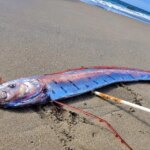
A photo of a giant oarfish, apparently found dead in northern Chile, has revived the myths and fears associated with what is known as the “doomsday fish,” amid speculation on social media platforms linking its appearance to the possibility of earthquakes, despite the absence of any scientific support to prove this.
According to a press report published by journalist Guy Wright on the Israeli “Channel 12” website, citing the “HIX” website, the photo spread this week, and circulating publications indicate that the fish was discovered on October 20 by people who were walking on a beach in the Mejiones region in northern Chile.
Some reports stated that the length of the fish was about 5 meters, while the Chilean radio station “Budauel” confirmed that no official confirmation had been issued yet regarding the authenticity of the documentation, the circumstances of its finding, or its precise measurements.
Oarfish, with long bodies, usually live in deep waters, so their emergence onto the beaches sparks widespread reaction due to their rare and unusual shape. The fears associated with it are based on Japanese folklore, which has long linked its appearance to disasters such as earthquakes and tsunamis, which appeared in the comments of some users of social media platforms in Chile, such as those who wrote warning: “An earthquake is coming to the north.”
On the other hand, scientific data confirms that these speculations are mere myths and not based on solid evidence. In this context, a study published in 2019 in the Journal of the American Seismological Society was based on data monitored in Japan to examine the hypothesis that the appearance of oarfish warns of earthquakes. The study did not find any precise scientific relationship that can be relied upon to predict earthquakes.
Accordingly, even if the authenticity of the photo from Chile is officially proven, the discovery of the oarfish does not carry any scientific indication of an imminent catastrophe, so the “doomsday fish” remains a phenomenon that arouses popular curiosity and panic without science possessing it to be an indicator of what is going on under the seabed.