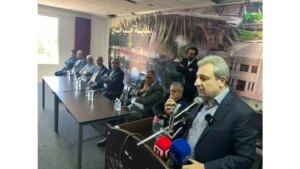
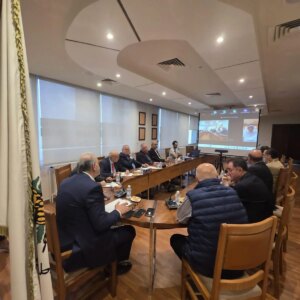
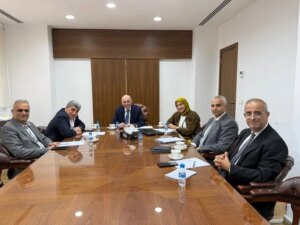
An expanded meeting held at the Ministry of Labor, headed by Minister Muhammad Haider, and bringing together representatives of the General Labor Union and economic bodies, resulted in reaching important understandings regarding several living and labor issues, led by a new mechanism for transportation allowance and raising family compensation, while the files of the minimum wage and end-of-service compensation were kept under discussion within a specific deadline.
Minister Haider announced the agreement to adopt a new mechanism that calculates the transportation fee equivalent to the cost of five liters of gasoline per day, to be calculated monthly based on the average fuel prices during the month. He explained that the executive mechanism will be formulated in coordination between the Ministries of Labor and Energy, with a minimum amount of 500,000 liras and a ceiling not exceeding 800,000 liras, indicating efforts to complete the decree and issue it during the current or next week at the latest, after completing the legal procedures and the State Shura Council.
Regarding the family compensation file, Haider indicated the agreement to raise its value to reach about 86% of 2019 levels, provided that the Board of Directors of the National Social Security Fund will complete the procedures leading to the issuance of the relevant government decree.
Regarding the minimum wage and end-of-service compensation, the Minister of Labor pointed to an agreement stipulating that periodic meetings of the indicator committee be held – in his presence and which includes the labor union and economic bodies – with a one-month deadline for submitting final recommendations in preparation for taking the appropriate government decision. Haider described the discussions as lively, stressing that they were keen to strike a balance between preserving workers’ rights and avoiding causing additional damage to the productive sectors.
For his part, the head of the General Labor Union, Beshara Al-Asmar, described the results as a qualitative addition, especially in terms of linking the transportation allowance to five liters of gasoline for workers subject to the labor law awaiting the issuance of decrees. Al-Asmar pointed out that there are large segments outside these understandings, revealing efforts and consultations with the three presidencies and the Minister of Labor to reconsider the “state royalty” on fuel to reduce the burden on them. He stressed that the minimum wage remains the biggest concern because it is insufficient as a standard, pointing out that the union will present the results to its office to take appropriate union positions.
In turn, the head of the economic bodies, Nicolas Chammas, stressed the keenness of employers to ensure the continuity of institutions and protect their employees, considering social stability is a common interest. Shammas believed that the private sector bears huge burdens of fees, taxes, and energy costs, stressing that the current crisis is regional and international and not purely internal, and stressing the need to reduce immediate burdens without burdening the private sector with the burdens of war, inflation, and tax policies.
These understandings come in the context of an ongoing consultative process to address living crises, awaiting the completion of government mechanisms to approve the transportation allowance and compensation decrees, in parallel with the launch of the Indicator Committee meetings to resolve the files of wages and end of service within the agreed upon time frames.