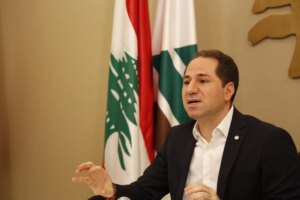
During a meeting in the Akkar district, the head of the Free Patriotic Movement, MP Gebran Bassil, launched a package of political and service positions, touching on the files of the general amnesty, the army, displaced Syrians, and the government’s performance, and announcing his movement’s move to a new supervisory phase through the launch of the “Government Observatory.”
Bassil explained, during a luncheon held for activists of the movement hailing from Akkar and residing outside it, that the exodus of the people of the region towards Beirut and Mount Lebanon reflects the state of deprivation that Akkar suffers from, which prompted them to search for a living, considering that “getting closer to Beirut brings the path of migration closer.” He described Akkar as a “reservoir of legitimacy and the movement,” noting that 11 percent of the movement’s members are from Akkar, which witnessed the highest membership rate during the last two years.
In the general amnesty file, Bassil denied the validity of the accusations against his movement of being hostile to the Sunni sect, pointing out that 27 percent of the movement’s members in Akkar (1,200 members) are Sunnis. He stressed that the movement defends the army and the oppressed, noting its movement since December 2025 to address the issue of “oppressed Islamists,” but at the same time he stressed its refusal to defend “the criminals who kill the army.” He cited the Battle of Nahr al-Bared, pointing out that more than 100 army martyrs were from the Sunni sect (including 17 from ancient Akkar), wondering what their families’ position would be if they were included in the amnesty. He stressed that “crime and justice have no caste,” refusing to pardon drug traffickers, military killers, and agents.
In a context related to the file of displaced Syrians, Bassil launched a sharp attack on the government, accusing it of “lying to the people” and of negligence in the file of their return. He explained that the government is talking about the return of 89 percent of them, while studies confirm that their number still exceeds two million. He considered that Akkar is still a gateway for smuggling Syrians, stressing his aspiration for it to be a gateway for good relations and free trade with Syria, and Lebanese participation in its reconstruction, not a corridor for illegal infiltration. Bassil warned of demographic change, wondering about the repercussions of the decline in the percentage of Lebanese residents to 55 percent, with expectations of it falling to 45 percent.
Bassil concluded by stressing that his movement would not be a verbal opposition, and announcing the imminent launch of the “Government Observatory.” He criticized the performance of the executive authority, accusing it of “playing with the lives of the Lebanese” through laws it supports, and attacking its policies related to citizens’ pockets and the electricity file.