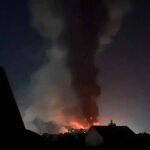
On Sunday morning, the Russian capital, Moscow, and its surroundings were subjected to a large-scale attack with hundreds of drones, killing two people and causing damage to a facility in the Moscow oil refinery, coinciding with the third and final day of the Russian legislative elections.
The Governor of the Moscow Region, Andrey Vorobyov, announced via the Telegram application shortly after three in the morning GMT, the interception of 249 marches, noting that the attack caused damage in several residential areas and the killing of a 44-year-old woman and an elderly man in two separate incidents. He added that 400 people were evacuated from a third site where a fire broke out as a result of a drone falling on a building.
For his part, Moscow Mayor Sergei Sobyanin reported in a series of posts on Telegram that air defenses shot down at least 186 drones, confirming that a facility belonging to the Moscow oil refinery was damaged, but no casualties were recorded at the site, while relief teams continued their work in the field. It should be noted that the refinery was subjected to several strikes in recent months as part of a wave of targeting that affected the Russian energy sector.
The source from which the marches were launched was not determined, but this attack comes in the context of an ongoing Ukrainian escalation to strike the Russian interior, especially energy and infrastructure facilities, with the aim of raising the cost of the war on Moscow, in response to the ongoing Russian strikes.
The attack coincided with the conclusion of the Russian legislative elections extending between September 18 and 20, which the ruling “United Russia” party is running amid complete control over the State Duma and the absence of the most prominent anti-war opposition forces.
The escalation comes despite US President Donald Trump confirming last Monday that both Russia and Ukraine pledged to stop targeting energy infrastructure. Ukrainian President Volodymyr Zelensky also announced his country’s readiness to take mutual “calming steps,” while the Kremlin described the proposal as a “good idea.”
In the diplomatic context, Zelensky announced his dissatisfaction with meeting Trump next week in New York, expressing his hope to resume direct talks with Russia after the legislative elections, while the Kremlin did not rule out holding an upcoming meeting in October.