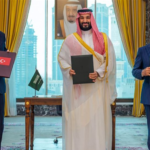
The visit of Saudi Crown Prince Mohammed bin Salman to Egypt today comes at a very sensitive regional time, amid rapid transformations that are redrawing the balance of power in the region, from Bab al-Mandab to Lebanon and Syria, all the way to the confrontation between Iran and the United States.
For this reason, the visit appears to be more than just a new milestone in Saudi-Egyptian relations. The timing and surrounding circumstances open the door to a broader political reading related to efforts to rearrange the Arab house and enhance coordination between the main forces in the region.
The scene today is crowded with developments: the Houthis are advancing in the Bab al-Mandab region, the Israeli war on Lebanon continues, while Israeli threats related to Syria and its south are escalating, in conjunction with the continuation of the war between Iran and America. In addition to all of this, the “Mecca Alliance” emerged, which includes Saudi Arabia, Turkey, and Pakistan, which raises questions about the shape of the new regional balances and the possibility of expanding this framework to include other Arab countries.
Amid this map, Bin Salman’s visit to Egypt acquires exceptional importance, especially since Cairo represents a fundamental weight that cannot be bypassed in any attempt to build a more cohesive Arab position.
In practice, Saudi Arabia seeks to strengthen Gulf solidarity and link it to a broader Arab space, while Egypt constitutes a fundamental pillar in any equation of this kind. If coordination between Riyadh and Cairo develops to a broader strategic level, this may give the Arab decision additional weight in dealing with successive crises.
And here precisely lies the importance of the Saudi-Egyptian rapprochement. The presence of Riyadh and Cairo within a convergent vision, in parallel with the growing relations with Turkey and Pakistan, could lead to the formation of a wide regional space capable of influencing issues of war, peace, and regional security.
For Israel, the crystallization of such a rapprochement will have its own calculations, as the rapprochement of major Arab and regional powers means that Tel Aviv may find itself facing a more cohesive political environment that is less amenable to dealing with it across separate Arab arenas, especially if political coordination turns into a common vision regarding the files of Lebanon, Syria, Palestine, and regional security.
Also, Saudi Arabia’s connection to a broader network of partnerships and alliances gives the Gulf states a greater margin in confronting any projects that may threaten the stability of the region or redraw their political and security maps.
However, the Gulf picture is not limited to Saudi Arabia alone. The UAE plays an influential role in the political and economic balances in the region, while Qatar maintains its role as a platform for mediation and rapprochement of viewpoints, in addition to its presence in the Palestinian file. As for the Sultanate of Oman, it still plays a pivotal role in negotiation and mediation channels between quarreling regional and international parties.
This distribution of forces may turn into an element of strength if it is brought together within a more coordinated Arab vision, instead of the movements remaining distributed among the capitals of the region. Hence, the biggest question arises: Will Egypt join the “Mecca Pact” if this framework tends to expand?
Until now, talk about such a step remains within the framework of possibilities unless an official announcement is made about it, but merely presenting the scenario reflects the scale of the ongoing transformations. In practice, Cairo’s accession to a framework that brings together Saudi Arabia, Turkey, and Pakistan, if achieved, will mean the birth of a regional bloc with great political, military, economic, and demographic weight. Then, the issue will not be just a new alliance, but rather an attempt to reshape the balance of power in the Middle East.
On the other hand, Egypt’s remaining outside any broad regional framework of this kind may limit its ability to express a comprehensive Arab decision, given Cairo’s historical, political, and military weight.
In conclusion, Prince Mohammed bin Salman’s visit to Egypt appears to be a stop worth monitoring, beyond the content of the bilateral meetings. Inevitably, the region faces a struggle for projects and influence, in light of Israeli expansion, an open confrontation with Iran, and rapid changes in the maps of alliances.
In the midst of these transformations, the Saudi-Egyptian rapprochement may be one of the most important keys to rebuilding the Arab balance. If Riyadh and Cairo meet within one path, and this path is integrated with the roles of the rest of the Gulf states and the partnerships of Türkiye and Pakistan, the region may be facing the nucleus of a new regional front.
Source: “Lebanon 24”