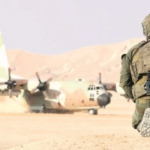
Yedioth Ahronoth newspaper revealed rare details about one of the most secret Israeli Air Force units, which specializes in establishing temporary runways for aircraft inside hostile territory, amid foreign reports about the establishment of two Israeli air bases deep in the Iraqi desert to support operations against Iran.
According to a report by journalist Yoav Keren, the unit is known as “Forward Landing Unit 5700,” and its mission is to identify suitable lands for transport aircraft to land, inspect, equip and secure them, then manage landing and take-off operations in areas far from Israel.
The Wall Street Journal reported on a secret Israeli military base in Iraq that was used as a logistics center during the air campaign against Iran, and included special forces and teams tasked with rescuing pilots if their planes were shot down. As for the New York Times, it said that Israel had established two bases for which planning began in 2024, and it quoted local residents that an Iraqi shepherd discovered one of them, before a helicopter chased his vehicle and killed him from the air.
Although the Israeli army refused to confirm this information, the report suggested that the unit participated in establishing and operating the two bases. One of its officers narrated that he participated in a secret operation outside Israel, during which a desert runway was prepared where no plane had previously landed, and several planes carrying troops and equipment were landed, after two weeks of preparation and training, and on a very dark night.
The unit commander said that his members are able to reach “almost any place,” explaining that the main obstacle is not the distance but the nature of the land. The “soil examiner” decides whether the runway can handle the Hercules C-130 aircraft, as any error could lead to the aircraft sinking into the mud, being damaged, or crashing.The personnel use simple tools to examine the hardness of the ground and measure obstacles, in addition to positioning devices, and some of them may even resort to tasting the soil to estimate its salinity and mineral composition.
The unit also includes air traffic controllers, field drivers, paramedics, drone operators and observers. Its members in the field transform into a “human control tower,” equipped with communication devices, night vision goggles, and tools for measuring winds, and it is responsible for giving the pilot final permission to land or take off.
One of the observers revealed that during a mission she had to delay the landing of a plane loaded with people after a sandstorm reduced visibility to less than 100 meters and then to zero, before the dust settled about 5 seconds before the plane touched the ground, so it was able to land.
The unit was established after the October War in 1973, and had previously prepared a runway for Hercules aircraft in Sudan during the transport of Ethiopian Jews in the 1980s. It also took over the operation of Beirut International Airport for the benefit of the Israeli Air Force during the Israeli invasion of Lebanon in 1982.
After the October 7 attack, the unit established runways to transport reinforcements near the Gaza envelope. During the war with Iran, it also established temporary runways away from the air bases that were being bombed.
The basic training course for its members lasts about 8 months, before they specialize in different fields. Since November 2023, the unit has been receiving women, who currently constitute about a quarter of its combat force.
The unit is affiliated with the 7th Wing of the Air Force, along with the “Shaldag” and “669” units, which are charged with search and rescue operations. Its commander confirmed that every Israeli pilot who sets off to bomb Iran knows that someone will come to rescue him, pointing to the unit’s ability to prepare front runways for rescue teams if requested to do so.
Thus, the report reveals that the Israeli Air Force does not rely on long-range aircraft alone, but rather on a small, highly secret network capable of transforming a desert spot behind enemy lines into a temporary air base within a short time.