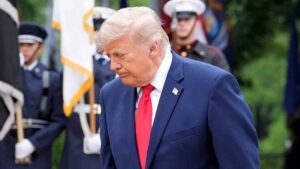
When the American bombing threat reaches Oman, a traditional ally of Washington and a mediator that has maintained open channels with Tehran for decades, the question becomes bigger than just a fiery statement by President Donald Trump: Does the language of repeated threats still achieve deterrence, or has it begun to lose its value and weaken the image of the United States instead of strengthening it?
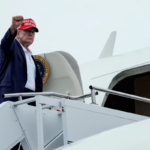
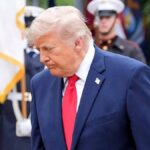
According to an article by writer Dan Perry in the Israeli newspaper “Maariv”, Trump said, according to what was reported by “Fox News”: “If Oman stands in our way, we will bomb it devastatingly,” in a phrase that the writer believed may be relatively familiar when directed at Iran, but becomes more strange when it targets a country allied with the United States.
Perry wondered whether this type of rhetoric was actually effective, and whether it represented a new way of managing geopolitics, or whether Trump had gone too far in using threatening language, calling for speaking more calmly but more clearly.
He pointed out that Oman has developed over the decades a delicate diplomatic equation, as it was a close friend of the United States, a partner of the Gulf monarchies, and a useful mediator between them all, while at the same time maintaining a margin of independence that allows it to talk to parties that Washington cannot communicate with directly.
He pointed out that Oman was the first Gulf country to publicly receive an Israeli leader, Yitzhak Rabin, in 1994, but it did not join the Abraham Accords.
The writer believes that this balance, despite the discomfort it may cause to external parties, has served Oman well, as it has preserved its stability and security in one of the most dangerous regions of the world, and given successive American administrations a diplomatic channel to Tehran.
He added that the Sultanate, whether during the era of Sultan Qaboos, who ruled it for many years, or during the era of his successor, Sultan Haitham, was ultimately a partner that could be trusted.
Precisely for this reason, Perry considers the current Omani behavior to seem more strange, as data indicate, according to his article, that Muscat is discussing with the authorities in Tehran a mechanism to reopen the Strait of Hormuz, which is vital for global energy supplies, which may give Iran a role in regulating navigation traffic and may include payments from commercial ships.
He explained that the details have not yet been decided, and that Oman may describe these amounts as service fees and not transit fees, which is a formula that Iranian officials previously tried to use. However, the writer believes that any formula of this kind would fundamentally undermine the existing system of global maritime trade.
He warned that the entire world may face concerns related to inflation and disruption of supply chains, especially Asia and Europe, but the longer-term problem is related to the principle of freedom of navigation, of which the United States was a guarantor.
He also expected that any precedent in Hormuz would lead to imitation attempts at other maritime choke points, not only in Bab al-Mandab, where the Iran-backed Houthis had previously disrupted shipping traffic, but also in the Bosphorus, the Strait of Malacca, the Sunda Strait, the Strait of Gibraltar, and other locations.
Perry believed that the current war was supposed to aim to overthrow the Iranian regime or push it to stop its pursuit of possessing a nuclear weapon, stop arming armed militias throughout the region, stop developing ballistic missiles capable of reaching Europe, as well as stop repressing demonstrators.
He noted that the war strategy and failure to build alliances and prepare for the situation in the Strait of Hormuz could be criticized, which he said he had personally done, but he considered that the goals themselves were “fair.”
He warned of a completely opposite scenario, in which the Iranian regime becomes stronger, the region becomes more turbulent, and the Iranian people are betrayed, while the Islamic Republic, which he described as one of the most tyrannical and hateful governments in the world, achieves a victory in Hormuz, which could deal a severe blow to the Iranian democratic opposition.
He stressed that this scenario should not be allowed to happen, suggesting that it will not be allowed in fact.
He believed that if the situation continues in this way, NATO countries may join the United States this time, even if they are forced to overcome their understandable aversion to Trump, noting that the options may range between imposing a complete and stifling blockade on Iran and returning to a more destructive military operation.
He explained that he personally prefers the first option, even if the global economy suffers temporary damage.
However, the problem, according to Perry, lies in the method through which Trump chose to deliver the message, considering it the least useful method.
He pointed out that Trump’s threats were previously capable of causing shock, including his statement 4 months ago that “an entire civilization will die” in Iran, a phrase that seemed crazy, but carried some credibility when he seemed to hint at the possibility of a nuclear war breaking out.
But when such threats become routine and become merely a show of force, according to the author, they weaken the position of the United States and make it appear desperate.
He added that Iran’s leaders, after testing the limits to this degree, seem to have come to believe that this is indeed the reality.
Perry likened the situation to the story of “the child who cried wolf,” even if the wolf this time was an American aircraft carrier.
He explained that the United States already possesses a tremendous capacity for destruction and everyone knows that, but the real question is whether the president is prepared to use this power in circumstances that entail political, economic, and strategic costs.
The writer believes that the answer, most of the time, seems to be “no.”
He described the threat to bomb Oman as “ridiculous,” especially since the Sultanate is a security partner of the United States, allows the American army access to its lands, and has played the role of a diplomatic channel between Washington and Tehran for decades.
He added that such a threat makes the person making it seem not serious, “and in Trump’s case, even less serious.”
Perry recalled the quote of former US President Theodore Roosevelt, who advised presidents to “speak quietly and carry a big stick,” considering that Trump had upended this equation.
According to the article, he speaks in an insanely loud voice, and although he carries a “very large stick,” he also appears impulsive, showy, and driven by immediate tactical needs.
He pointed out that what is known as the “mad man theory” can succeed when opponents believe that behind the apparent irrationality is a real willingness to take risks, but Trump, according to Perry, often fails to establish this belief.
The writer believed that the issue should not be this complicated, as Oman has many reasons of its own to keep Hormuz open, and it also has a great interest in maintaining its relationship with the United States.
He explained that the Omani economy depends largely on energy and international trade, and that its security relationship with Washington is particularly important.
He recalled that Oman was the first country in the Gulf to grant the United States official military access to its facilities, and since then the two countries have developed extensive security cooperation.
An agreement concluded in 2019 also expanded US access to the ports of Salalah and Duqm, with the ability of Duqm Port to receive US aircraft carriers.
He pointed out that Oman also has oil and gas reserves that give its government a large economic margin, while its population is about 5 million people, and its standard of living provides the Sultanate with a degree of independence that many countries can only dream of.
Therefore, it is not a poor country desperately searching for a source of income.
If necessary, Perry believes that the United States has great pressure tools on the Sultanate, but an important part of the power of these tools is precisely because Washington does not want to use them in a destructive way.
The United States could, according to the article, reconsider military access, review arms sales and maintenance arrangements, reduce intelligence and security cooperation, and impose specific sanctions on parties that assist Iran’s control mechanism, as well as use its significant diplomatic and financial influence to make clear that Oman’s decisions will have consequences.
Washington can also coordinate its actions with Saudi Arabia, the UAE, and other partners whose interests are directly affected by the future of the Strait of Hormuz.
Perry described these tools as real means of pressure, and they can be used gradually, so that Washington makes the results more painful step by step, while leaving a clear path for Oman to retreat.
He believes that this is how a great power should deal with a partner whose behavior it considers unacceptable: making the price clear in an unambiguous manner, while at the same time maintaining a relationship that essentially allows for the application of pressure.
As for bombing Oman, according to the writer, it will achieve almost the opposite result, as it will destroy an important American relationship, threaten American military access, harm a valuable diplomatic channel with Iran, and may push Muscat to be convinced that its future security requires getting closer to Tehran.
It could also turn a dispute over shipping arrangements into a much broader geopolitical rift, making the United States look less like a confident superpower using leverage and more like an angry power that suggests it has exhausted its best options.
Therefore, Perry calls on Washington to address Oman as it would address “a friend who made a very serious mistake.”
He also demanded that it make clear, something he said Trump had surprisingly not done, that the international community would not allow an arrangement that would give Tehran a recognized ability to regulate international navigation in the strait or generate revenues from it.
He believes that the United States should inform Oman that it prefers to resolve the issue among friends, and that continued cooperation gives the Sultanate enormous benefits, while continued assistance in establishing an Iranian mechanism within Hormuz will necessarily change the nature of the relationship.
According to the writer, military access, arms sales, intelligence cooperation, financial relations, and diplomatic support are all files that must become subject to review if Muscat chooses to cross this line.
Perry concludes that the part related to the consequences for Oman must be conveyed calmly and with complete clarity, without leaving room for maneuver and without theatrical threats, considering that this is the form of true deterrence: actually carrying a “big stick,” and trying not to use it, and most importantly, do not repeatedly shout “wolf” until the threats lose their credibility.