The Washington Post revealed new European diplomatic moves aimed at breaking the deadlock in the negotiation process between the United States and Iran, in light of the expanding economic repercussions of the closure of the Strait of Hormuz and the decline in the US administration’s margin of maneuver.
According to the newspaper, the administration of US President Donald Trump has included Austria and Greece in the communications process, as part of its efforts to expand the circle of communication with countries that may contribute to putting pressure on Tehran or push it to soften its hard-line stance, after the efforts of traditional mediators faltered.
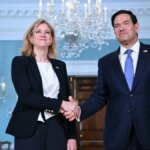
In this context, US Secretary of State Marco Rubio met on Tuesday with Austrian Foreign Minister Betty Meinel Reisinger in Washington, before he held a phone call on Wednesday with Greek Foreign Minister George Gerapetris.
Following these talks, the Austrian and Greek ministers, on Thursday, held two telephone calls with Iranian Foreign Minister Abbas Araqchi.
Although the US State Department denied the existence of a relationship between Washington and these contacts, the Washington Post quoted a European diplomat as saying that their timing was not a coincidence.
The US State Department said on Friday that it cannot comment on the timing that other countries choose to conduct their foreign communications, stressing that Rubio did not ask either minister to communicate with Iran or convey messages to Araghchi.
However, the US State Department acknowledged that the Iranian issue was present in Rubio’s discussions with the two ministers, at a time when Trump faces challenges related to the continuing conflict with Iran without a resolution.
The entry of Austria and Greece into the line of communications comes amid efforts to accelerate the end of the conflict, in light of the economic repercussions resulting from the closure of the Strait of Hormuz and its impact on many countries outside the Middle East.
Although Austria and Greece are not considered traditional options for mediation in the US-Iranian conflict, each of them has factors that give it a potential role in this path.
The Austrian capital, Vienna, hosts the headquarters of the International Atomic Energy Agency, which is expected to play a pivotal role in any settlement related to the Iranian nuclear program, and it also previously hosted the final negotiations that led to the nuclear agreement in 2015.
As for Greece, it is considered a major maritime country in the Mediterranean, with broad interests in the shipping sector and significant activity linked to the Strait of Hormuz and the Red Sea. During his call with his Iranian counterpart, its Foreign Minister focused on “the importance of freedom of navigation and maritime security.”
These moves come as the time limit stipulated in the memorandum of understanding signed by the United States and Iran last June is entering its final days, officially ending on August 17.
According to analysts, Trump faces a limited margin of maneuver in the conflict with Iran, in light of the economic consequences of the war and the diminishing strategic stocks of major weapons, which constitutes a political impasse for the Republican Party before the midterm congressional elections scheduled for next November.