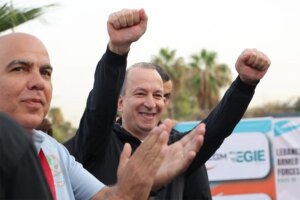
The Ministerial Committee for Reconstruction and Economic Recovery held its meeting in the Grand Serail, at three in the afternoon, headed by Prime Minister Nawaf Salam, and the presence of ministers: Finance Yassin Jaber, Energy and Water Joseph Al -Sadi, Social Affairs Hanin Al -Sayed, Communications Charles Al -Hajj, Public Works and Transport Fayez Rasamani and the Environment Tamara Al -Zain, Secretary General of the Higher Relief Authority, Brigadier General Bassam Nabulsi, Chairman of the Council of Development and Reconstruction Qabbani and South Speaker Hashem Haider.
The committee restored, according to a statement, as an affirmation of what was stated in the government’s ministerial statement, and renewed “the government’s commitment to expedite the reconstruction of what was destroyed by the Israeli Adwan, despite the ongoing attacks and the scarcity of public and international financing, so staying in a state of stalemate is not an option.”
She explained that “the strategy of recovery and reconstruction revolves around preserving the dignity of the affected citizens and ensuring their basic rights, and that it adopts more sustainable reconstruction plans, in a way that guarantees transparency and enhances citizens’ confidence in their country.”
The statement pointed out that “the strategy focuses on three parallel tracks:
– Enhancing the resilience of the returnees to their Lebanese villages and displaced people through social financial assistance aimed at supporting livelihoods and securing temporary shelter.
Launching urgent measures to restore basic infrastructure and support economic and living initiatives.
– Preparing an economic development program for the war -affected areas, as a first stage of a more comprehensive national strategy.
The committee pointed out that “the implementation of the strategy will depend on three sources: grants, loans, and the public budget, so that each government administration takes part of the tasks according to its jurisdiction.
Regarding housing and accommodation, the Ministry of Social Affairs will launch the “Criticism for rent” program in October 2025, in addition to what was devoted from the general budget for the South Council and the Supreme Relief Authority to support the affected residential buildings.
In the field of social empowerment, the Ministry of Social Affairs continues to implement the “Monetary Transfers” program, which targets 265 thousand people from the Lebanese displaced Dakhia, which started in July 2025 for a period of six months, pending gradually merged into the “Aman” program.
In parallel, in the economic field, the United Nations agencies implement a number of development projects in coordination with the relevant ministries and the Council for Development and Reconstruction, which supervises the GATE loan ($ 200 million from the World Bank) aimed at modernizing the agricultural sector, developing rural infrastructure, and supporting farmers and small institutions.
With regard to infrastructure, the Council for Development and Reconstruction also oversees the leap loan ($ 250 million expected to be approved by the House of Representatives, in addition to financing of 75 million euros from the French Development Agency) for the reconstruction of the war that is affected by the war and the restoration of basic services.
The statement stated that “the Prime Minister confirmed the conclusion of the government’s commitment to move forward in the reconstruction and economic recovery workshop, and will continue to follow up with the senior donors to the ongoing preparations for the upcoming international conference to support Lebanon, which was previously announced by French President Emmanuel Macron.”
The post The Ministerial Committee for Reconstruction met with the presidency of Salam: The implementation of the strategy will depend on grants and loans appeared first on 961 tobay Lebanon today.