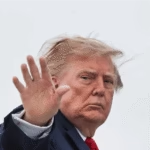
US President Donald Trump issued a series of strong statements on his “Truth Social” platform, declaring the end of the Strait of Hormuz crisis, and confirming that Iran has agreed not to close it again, and that it “will no longer be used as a weapon against the world.”
Trump said that he received a call from the North Atlantic Treaty Organization (NATO) offering to provide assistance, adding that he told them “to stay away, unless they just want to load their ships with oil,” describing the alliance as “useless when it was needed,” likening it to a “paper tiger.”
He stressed that Iran, “with the help of the United States,” has removed or is working to remove all sea mines, considering this an indication of the stability of freedom of navigation in this vital corridor for global energy transport.
He also expressed his thanks to the Kingdom of Saudi Arabia, the United Arab Emirates and Qatar for what he described as “great courage and assistance,” in addition to Pakistan, its prime minister and military commander, describing it as “a great and bright day for the world.”
Regarding Lebanon, Trump stressed that the agreement with Iran “is not linked in any way to Lebanon,” adding: “We will make Lebanon great again,” referring to a separate path that Washington pledges to work on.
His speech was not without criticism of the American media, including the New York Times and CNN, accusing them of searching for reasons to criticize him regarding the Iran issue, and calling on them to recognize what he considered a success in managing the crisis.
Trump’s statements come after a period of intense tensions in the Strait of Hormuz, which raised international concerns about disruption to shipping traffic and rising energy prices. This strait is a strategic corridor through which a large portion of global oil exports passes, making any threat to close it carry major economic repercussions.
These developments coincided with intense diplomatic efforts between Washington and Tehran, including security and maritime arrangements, at a time when the US administration seeks to establish a broader calm in the region, including also the Lebanese arena, within the framework of an approach that separates issues while keeping channels of communication open.