November 11, 2026

The Iranian-American file is witnessing escalating field and political tensions, coinciding with conflicting statements by US President Donald Trump regarding the fate of the negotiations aimed at ending the military confrontation, and a sharp division within the US administration over future options for dealing with Tehran.
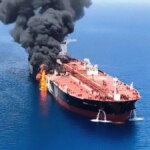
In field developments, the naval forces of the Iranian Revolutionary Guard announced that two oil tankers were hit by sea mines while sailing in the Strait of Hormuz, which led to them catching fire and the departure of their crews. The Iranian army confirmed its control over the area east of the strait, stressing that safe passage requires prior coordination and compatibility with Iranian naval systems, and publishing scenes of a column of smoke and fire in the middle of the water.
On the military and nuclear level, the Chief of the General Staff of the Iranian Armed Forces, Ali Abdullah, issued strong warnings to Washington and Israel, considering that the previous attacks were only the beginning. In the same context, the Secretary of the Iranian Supreme National Security Council, Mohsen Rezaei, decided on his country’s position by refusing to export any part of the enriched nuclear materials abroad, revealing during his recent visit to Moscow and his meeting with Russian President Vladimir Putin, plans to use it locally to operate nuclear ships and submarines. Rezaei, who also indicated progress in the electronic war to control and shoot down American drones, confirmed that Tehran requires ending the war on all fronts in West Asia, especially in Lebanon, in order to reach a settlement, warning against targeting long-range American bases in the event of renewed attacks.
For his part, Iranian President Masoud Pezeshkian commented on the possible American threat to use the “mother of all bombs,” asking who is the party that threatens global peace and security. This came at a time when the Iranian authorities announced the arrest of five people on charges of cooperating with American and Israeli intelligence and planning attacks in Tehran, Alborz, and Kermanshah.
Regarding military capabilities, a report by Bloomberg Network, based on Western intelligence estimates, stated that Iran possesses about 1,700 ballistic missiles and is capable of producing 50 missiles per month, at a slower pace compared to before the war. The report also pointed to questions about the results of the Israeli military operation “Lion’s Roar,” which focused on infrastructure and energy facilities more than directly targeting nuclear facilities.
On the American side, according to a report by journalist Lior Ben Ari on the Yedioth Ahronoth website, a senior Israeli official reveals an unprecedented division within the Trump administration. Defense Secretary Pete Hegseth and Centcom Commander Bradley Cooper support the resumption of military operations to end the Iranian threat, while Chairman of the Joint Chiefs of Staff Dan Kaine shows hesitation in this regard. On the other hand, Vice President J.D. Vance, envoy Steve Witkoff, and Jared Kushner are all opposed to renewing the war, preferring diplomacy, while Treasury Secretary Scott Besent sees only tightening the economic blockade to “stifle” Iran, while Secretary of State Marco Rubio is avoiding taking a decisive public stance, amid continuing ambiguity about the direction that Trump will ultimately choose.