October 18, 2026

A report published by the “Al-Monitor” website and translated by the “Lebanon 24” website showed that global oil stocks fell to their lowest levels in nearly a decade, affected by the repercussions of the war with Iran and disturbances in the movement of maritime shipping through the Strait of Hormuz. This decline weakened the ability of global markets to absorb any additional interruption in supplies, amid mounting warnings of rapid jumps in prices if the depletion of stocks continues.
In this context, the CEO of Saudi Aramco, Amin Nasser, warned on October 5 that the world had lost about 3 billion barrels of total oil supplies since the outbreak of the war in late February. He explained that this quantity is equivalent to about half of the crude supplies and derivatives that were supposed to cross the Strait of Hormuz during the same period under normal circumstances, stressing that the global supply system is facing increasing pressure and a very limited ability to absorb shocks.
For its part, Kpler data reported that global monitorable crude oil inventories decreased from 3.7 billion barrels in March to 3.35 billion barrels in early October, recording a decline of 350 million barrels. However, the company’s chief crude oil analyst, Johannes Raubal, explained that these numbers do not accurately reflect the quantities actually available for use, given the presence of millions of barrels necessary to operate tanks, pipelines and refineries (between 10 and 15% of tank capacity), as well as the presence of underground reserves in countries such as China and Saudi Arabia that are not included in the monitored data.
In terms of export movement, crude oil shipments from the Middle East witnessed a temporary recovery during September, exceeding pre-war levels on September 24 and between September 27 and 29, to range between 19.5 and 22.5 million barrels per day. However, the renewed attacks led to a new setback. Quantities transiting through the Strait of Hormuz decreased to about 10 million barrels per day in October, compared to about 11 million barrels in September.
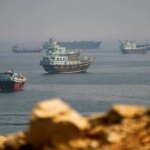
Maritime navigation witnessed its most dangerous period since the outbreak of war, as 26 ships were subjected to attacks since the beginning of October, according to data from companies tracking incidents, the most prominent of which was the sinking of the container ship “GFS Pride,” flying the Singapore flag, on Wednesday after it was hit by a projectile. In this regard, the founder of the energy market analysis platform “JKempEnergy”, John Kemp, warned that the continued depletion of stocks portends a rapid rise in spot prices and oil contract spreads, noting that the return of flows to normal and the stability of stocks will require a period ranging between 24 and 36 months of gradual rebuilding.
In an effort to contain the crisis, the G7 countries announced on October 2 plans to pump 100 million barrels of strategic reserves through the International Energy Agency over a period of four months. This followed a previous pledge by the agency in March to release 400 million barrels (325 million of which were pumped by October 2). On October 15, the agency’s member states agreed to accelerate the release of the remaining quantities of 100 million barrels, including more than 20 million barrels of diesel, so that Nahle withdrawals exceeded the original pledge and amounted to about 330 million barrels.
In addition, the report indicated that the biggest crisis is related to oil derivatives, specifically diesel and jet fuel, whose prices were affected by the war in the Middle East, the Ukrainian attacks on Russian refineries, in addition to Russian and Chinese restrictions on fuel exports. Callum McPherson, head of the commodities department at Investec Bank, confirmed that the problem lies in the shortage of finished products that are directly consumed by the market, pointing out that increasing crude supplies alone will not compensate for this shortage unless refining and logistics capabilities are available.
The report concluded that market stability requires a sustainable return to oil exports at levels exceeding current consumption to compensate for supply losses, stressing that the temporary recovery of shipments or withdrawal from strategic reserves remains insufficient to rebuild depleted stocks in the long term.