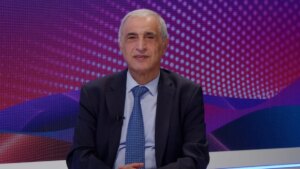
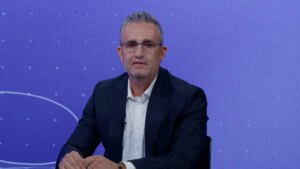
Representative Hassan Murad affirmed during the graduation ceremony of students at Al-Sharq University in Tripoli that Tripoli is a city with potential that qualifies it to be an economic, scientific and tourist capital in the Eastern Mediterranean, and that its development and equity are a national interest, calling for a state plan to activate its port and facilities, encourage investment, and involve its youth in building the Lebanese economy.
On the educational issue, he stressed a national project that enhances formal, university and vocational education, scientific research, innovation and technology, does justice to teachers and links education to the labor market, holding the Ministry of Education responsible for controlling tuition fees and monitoring school budgets.
He called for the adoption of a unified, scientific, objective and national history book, far from political and sectarian calculations, as an essential part of building the state and the common future.
Based on his vision of state building, Murad called for the establishment of a state governed by law and institutions, and protected by the Taif Agreement, reiterating that negotiations and diplomacy do not mean giving up rights and sovereignty, and that “the victory of the Lebanese over the Lebanese is a defeat for Lebanon.”
In this context, he saw that the true state is a strong state that owns its decision, protects its people, preserves its borders and sovereignty, and imposes respect for Lebanon at home and abroad, far from temporary settlements and discretion, considering that force in its various forms constitutes the basis of protecting Lebanon, its decision, and its independence.
Murad also denounced the continuation of the aggression, demanding the withdrawal of the occupation from Lebanese territory, the release of prisoners, and the safe return of the families, stressing that reconstruction is the duty of the state, and calling on the government to take continuous diplomatic and legal action, document Israeli violations and submit them to the Security Council, and place the international community before its responsibilities.
He said that Lebanon can only be governed by balance, partnership, consensus, and respect for the constitution and the Taif Agreement, far from the logic of dominance and betting on the outside, stressing that whoever wants a strong Lebanon must build a strong state at home, with its army, institutions, and the unity of its people.
At the regional level, Murad condemned the Israeli attacks on Syria and the violation of its sovereignty, stressing that its security, stability and territorial integrity are Arab and Lebanese interests, and that the issue of Palestine is an issue of right, justice and dignity that requires an international stance to protect civilians and stop the aggression, and that the attack on any Arab land cannot turn into a normal matter to which the world is accustomed.
Regarding Lebanon’s identity and its Arab relations, he pointed out that Lebanon is an Arab country of identity and belonging, and that its Arabism is part of its constitution, history, and future, calling for a Lebanon that is open to the world, adheres to its Arab identity and depth, and is a bridge within its Arab nation, not an island separate from it.
He pointed out that “Lebanon is linked to its Arab brothers, led by the Kingdom of Saudi Arabia, the Gulf states, Egypt, Syria, Jordan, Iraq and other Arab countries, with relations based on respect, cooperation and common interests,” stressing that Lebanon wants the best relations with its Arab brothers, state-to-state relations, based on mutual respect and non-interference in internal affairs, and on cooperation for the benefit of all our peoples.
He explained that experiences have proven that Lebanon is stronger when it is embraced by its Arab depth, and that the unity of the Arab word in defending Arab rights strengthens Lebanon’s presence, voice and influence in international forums.
Regarding his relationship with Representative Faisal Karami, Murad said: “We may agree on some positions, and we may differ on other positions, but what has not changed is that we were and remain in one national trench, united by constants greater than the details,” considering that “national homes are not measured by what they achieve for themselves, but by what they provide for their country and its people.”
Murad concluded by stressing that Lebanon at this stage needs a lot of wisdom and a little bidding, and a speech that unites and does not divide, stressing that Lebanon does not end as long as there is a generation in it that refuses to surrender.