Only a week after a Syrian announcement that the International Atomic Energy Agency was preparing to release “nuclear materials” found in a secret location inside the country, Damascus changed its position and announced that it would keep these materials in its possession to be used for “peaceful purposes,” in a move that brought the file of the former regime’s nuclear legacy back to the forefront, coinciding with the visit of the Agency’s Director General, Rafael Grossi, to the Syrian capital.
According to a report by journalist Lior Ben Ari and the “Reuters” agency, published on the Israeli “ynet” website, Syrian Foreign Minister Asaad Al-Shaibani announced, on Tuesday, the retraction of the decision to remove the nuclear materials, stressing that they will remain in Damascus’ possession for peaceful purposes, provided that they are subject to the guarantees provided by Syria to the International Atomic Energy Agency.
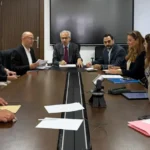
Al-Shaibani’s position came during a joint press conference with Grossi, who arrived in Damascus as part of following up on cooperation between the Syrian authorities and the agency.
Al-Shaibani said: “Syria has the right to use the materials for civilian purposes,” adding that “cooperation between Syria and the International Atomic Energy Agency has reached advanced stages.”
He continued: “We are dealing with the legacy of the previous regime regarding nuclear activity, and the new Syria is looking forward to cooperation.”
Damascus also declined to confirm a report that talked about months of contacts with Israel against the background of the nuclear file.
In parallel, Al-Shaibani attacked Israel, which was reported to have carried out a strike inside Syria overnight, and said: “Today we stand together to demonstrate our commitment to being a pillar of stability at the regional and international levels, while Israeli forces continue their policy of aggression and chaos.”
He added: “We reaffirm Syria’s sovereignty and call for an immediate cessation of Israeli violations.”
Last week, the Syrian Atomic Energy Authority announced the expected visit of a delegation from the International Atomic Energy Agency, and then confirmed a report regarding the evacuation of nuclear materials from Syrian territory, which has now been retracted.
According to Israeli and American officials who spoke earlier to the Axios website, the international agency’s actions in Syria came after the administration of US President Donald Trump reached understandings with Syria and Israel.
According to the report, the scenes witnessed an exchange of threats and dramatic diplomatic moves that continued for months, before a solution was reached a few weeks ago.
The file dates back to the era of the former Syrian regime headed by Bashar al-Assad, which developed a secret nuclear program centered around the secret reactor in al-Kubar.
After Israel bombed the reactor in 2007, the bulk of the Syrian nuclear program was destroyed, but a number of research, development and storage sites remained in place, while most of them witnessed little activity.
After the fall of the Assad regime, the International Atomic Energy Agency signed an agreement with the new Syrian authorities, allowing its inspectors to visit the Al-Kibar reactor and a number of other sites linked to previous Syrian nuclear activity.
According to the report, one of the facilities that Israel closely monitored over the past two years was known as “Site 99.”
Two Israeli officials said that the Assad regime was storing nuclear materials at the site that were part of the Al-Kibar reactor project.
An American official explained that the materials found there included “yellowcake,” which is a powder extracted from uranium that can later be subjected to processing and enrichment within the nuclear fuel production cycle.
He added that the former regime also stored remnants and other waste inside “Site 99” originating from the Al-Kibar reactor site, which was bombed.
Although the materials found at the site cannot be used to produce a nuclear weapon, the report indicated that they could be used to make what is known as a “dirty bomb,” which is a conventional device that disperses radioactive materials with the aim of contaminating a specific area, instead of causing a nuclear explosion.
Israeli officials said that the Israeli army bombed the entrances to the site shortly after the fall of the Assad regime, with the aim of preventing access to it.
According to an American official, Israel and the United States discussed for more than a year the best way to deal with “Site 99,” while officials in the National Security Council in the White House and their counterparts in Israel worked in close coordination on the file.
An Israeli official said that Jerusalem clearly informed the Trump administration that it would not agree to keep nuclear materials at the site.
Thus, Damascus’s decision to keep the materials under International Atomic Energy Agency (IAEA) guarantees reopens one of the most sensitive files of the former Syrian heritage, at a time when Syria’s declared right to civilian use of the materials intersects with a clear Israeli objection to their survival, amid direct international follow-up of the file.