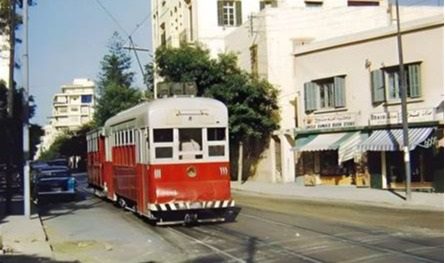
Beirut’s tram 1909- 1965
In 1908, a Belgian company composed of Ottoman and Belgian capitalists obtained a privilege from the Ottoman Sultanate to run an electric tramway in Beirut instead of trailers that were drawn by mules and horses. This privilege was to operate the tramway on the power, provided that it was never interrupted, and that Beirut was provided with lighting.
In 1909, the electric “tramway” was launched in Beirut and its appearance was an exceptional event, and the Beirut neighborhoods arrived with each other, and in the area of the Furn Al -Shibbak, the border point separating the time between the Mount Lebanon and the state of Beirut, in order to facilitate the transportation of the residents between the two states, and the city’s sons reached two train stations in Mar Mikhael and the port to facilitate the movement of goods.
The form of tramway differed from one year and another. It was first in two forms, including the closed, large and wide, accommodating fifty passengers and weighing 7 tons, including the middle shape of thirty passengers and weighing 4 tons, and it was composed of two parts of women and another for men.
On June 2, 1954, the Lebanese state resulted in the tramway and renewed the largest part of its vehicles, and was forced to raise the price of the ticket from two and a half piasters to 5 piasters without touching the price of the first -class ticket, which led to a popular uprising.
Tramway lines
The tramway linked Mount Lebanon to Beirut, through the area of the Furn Al -Shibbak, where the central station was focused.
At the end of the era of the Ottoman Sultanate (1908-1918) there were 5 lines:
The first line: Al -Shabak oven -Bab Idris -American University -Ras Beirut -Al -Manara.
– The second line: Al -Hamidiya Square (Al -Shah Square today) – Beirut Damascus Road – Al -Shabak.
– The third line: Al -Ittihad Square (Riyad Al -Solh Square today) – Al -Basta – Al -Harash.
Fourth line: Al -Shabak oven – Fosh Street – Al -Mufar Street – Train Station.
Fifth Line: Al -Shabak oven – the tower – the river – the course.
The French developed the tramway lines and made them in both directions back and forth after they were in one direction, and expanded the roads in places that are not a threat to public safety.
In 1964, the state decided to stop the tramway, and China bought a number of its buses, while others went to scrap dealers, or turned into restaurants.
Difficulties restarting it
Sources in the General Directorate of Land and Maritime Transport via “Lebanon 24” say that “it is difficult to create a new tramway in Lebanon because of the logistical and financial challenges and the deteriorating infrastructure, in addition to the historical and political factors that led to the reduction of the spaces allocated to the streets and the preference of using cars at the expense of public transport”, noting that “the absence of vision and political and economic stability represents a major obstacle to implementing large projects such as networks such as networks Tramway.
She pointed out that “the great urban expansion in Lebanese cities, especially in the capital, Beirut, led to the preference of the use of private cars, which led to the removal of the historical tramway paths to expand the roads to accommodate vehicles, and therefore this matter constitutes an obstacle to such a project.”
She pointed out that “a new tramway building needs a strong and developed infrastructure, which our cities lack due to successive wars and the successive economic crises that the country has gone through.”
In addition, the streets in cities are narrow and not prepared to create new tramway tracks, which increases the difficulty of planning and implementing.
Also, building a new tramway network requires complex engineering works, such as the extension of electricity networks and street rehabilitation, which may be impossible to implement in the current circumstances due to the encroachments and urban expansion, without forgetting that financing such a project requires significant investments.
On the other hand, he learned that a number of investors are studying the idea of establishing a tramway in partnership between the state and the private sector to be presented to the relevant authorities soon. Will the Lebanese dream of seeing a “tramway” or a train soon will be achieved, or will this project remain ink on paper?
The post 60 years after he stopped .. Tramoy Beirut see! appeared first on 961 tobay Lebanon today.