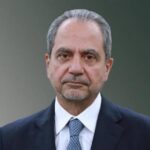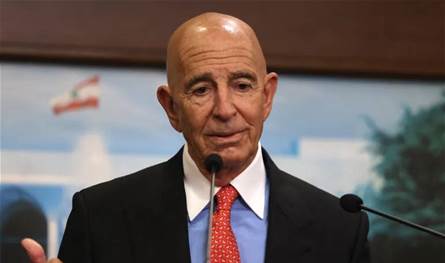
Tom Brak’s words about the Lebanese government, the army and resistance did not go unnoticed, but he also did not face formal political reasons at the expected level, which opened the door to questions about the Lebanese position and how he managed the political discourse coming from abroad, as the positions issued so far have appeared hesitant and shy, the least compared to the official position of other statements, may be less dangerous, as recently happened with a number of Iranian officials.
While the Speaker of Parliament Nabih Berri was clear and firm in rejecting the descriptions made by Barak, especially as it contradicts what he previously said in the Lebanese capital Beirut, Prime Minister Nawaf Salam was satisfied with the amazement of the Barak’s statements that he considered to be “questioning the government’s seriousness and the role of the army”, stressing that his government is committed to implementing its entire ministerial statement, especially in terms of the authority of the state. On its entire land with its own forces, and restricting the weapons with its hand alone.
Between Berry’s refusal and the amazement of peace, there are question marks that arise about whether these positions really rise to the level of “the danger” of the statements of the international envoy, which some say that he emphasized again the “bias” of the United States, as “Hizban” with the enemy and the opponent, and others believe that it warns of the expansion of the battle, but “blessed” somewhere in the Israeli escalation, after the Lebanese were the pressure on it Israel must persuade it to withdraw from the points it occupied.
Explicit refusal and confirmation of the constants
It may not be surprising that the position of Parliament Speaker Nabih Berri is highly tone, as he categorically refused to describe Barak to the army, the government and the resistance, and considered it offensive and unacceptable. Through his direct language, Berri seemed to put a standard for the official Lebanese position, calling for not to be late in the response, as if he was honest with the laxity that weakens the image of the state in front of the interior and abroad, especially since the statements involved “insulting” the state as a whole, and not only a Lebanese segment.
Also, Berri’s statement reflects its traditional position as a defender of the legitimacy of the Maqaqa, and a welding of its partnership with the state. He not only stopped when criticizing the content of Brak’s statements, but went further to put the political framework for the response: an absolute refusal and not bargaining on the existing equation between the army, the resistance and the government. In this sense, Berri’s words were not only in defense of the Maqaqa, but also an attempt to draw a red line in front of any external endeavor to redefine the role of the state or its institutions.
But beyond that, those who know that this position, in his severity, reflects a wild “dissatisfaction” of the statements, especially as it contradicts what he had heard from the American delegate during his recent visits to Beirut, which is what he fears is a “displacement” of all the discussions he undertook during the period of his assumption of negotiations, especially since Barak, who “doubts” today, is the government of the government “Noua” this role on more than one occasion, which raises suspicion to a large extent.
What next?
It may also not be surprising that the position of Prime Minister Nawaf Salam comes less strict than that which was issued by Berri, but that there are those who see that the mere issuance of a “response” to Barak’s words about him is considered a positive step registered for him, even if he was satisfied with the surprise of the American delegate’s statements, and confirming his government’s commitment to the issue of restricting arms in the hands of the state, in a repetition of an equation that he knows before it is the subject of internal controversy. God ”is still rejecting it in public.
Thus, a peace statement appeared as if it was an attempt to reconcile the refusal of insult on the one hand, and avoiding entering into a direct confrontation with the external position on the other hand, knowing that Salam tried to avoid this confrontation, by delaying the response, and that some of the previous leaks of his statement indicated that he responded to the Minister of Energy, who had provided that a government position responded to Barak’s statements, that “there is no need for that.”
And if there is those who criticize a peace position, given that it did not rise to the level of confrontation, then there are those who consider that political realism imposes not to jump above this level specifically, especially since Lebanon at the present time needs to support the international community, and therefore any political confrontation, calculated or not calculated, with the United States, will not benefit him with anything, but will complicate things more, and may open the wide door to a new round of fighting.
In the entirety, the Lebanese responses to the statements of Barak refused to reject it, whether through the statement of Berri Al -Hazem or through a peace position, which stressed his government’s commitment to the constitutional principles. But the questions remain open about the ability of these positions to curb the repercussions of the words of the American delegate, and whether it will be sufficient to install the state image in front of the challenges of the next stage, amid fears and concerns that seem legitimate, from his statements to be a precursor to an unknown ..
The post The Lebanese responses to the words of Barak .. Do you rise to the required level?! appeared first on 961 tobay Lebanon today.