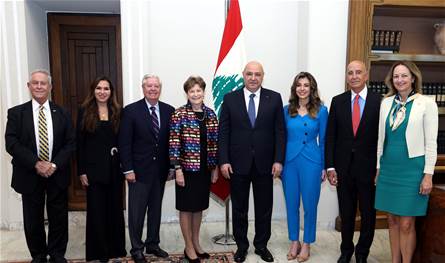
The visit of the American delegation headed by Tom Brak to Beirut did not pass like its predecessors, as it carried direct messages and unprecedented pressures, which soon blew a political and media debate about Washington and Riyadh’s intentions at this stage. Instead of including concrete steps from the Israeli side, which paved the way to complete the political initiative, it came loaded with a series of new demands and challenges.
This path was considered by the Speaker of Parliament Nabih Berri out of what was expected, given that the bet was on Israeli obligations pushing the political path forward, not on an American agenda that seemed urgent to push matters towards the clash. Informed political sources believe that the American delegation did not come as a mediator seeking to bring views, but rather as a party that fully adopts the Israeli demands. This was evident in the tone that was used during the statements and which did not carry any diplomatic soul, but rather looked closer to predetermined political statements in Washington, than to positions issued by official Lebanese platforms. This language clearly reflected that the internal platforms were used to market an external discourse that pressure Lebanon more, which opens the door to a political settlement. Severe sources indicate that the American -Saudi goals do not stop at the boundaries of weapons, but rather exceed it towards the civil, social, service, and even health structures related to “Hezbollah”, in an attempt to dry any institutional presence for it. As Riyadh, according to the same sources, considers that the current moment is a historical opportunity to achieve a strategic penetration, while Washington seeks to invest this motivation without going to the option of civil war, realizing that the results of this scenario are not guaranteed and its repercussions may be out of control. The first is based on preventing the idea of a clash and implementation by force, even if this leads to the description of Lebanon as a “failed country”. As for the second, it is based on the fact that Lebanon has fulfilled all the conditions stipulated in Resolution 1701 after bearing the cost of Israeli attacks throughout the last period, and thus inviting the international community to compel Israel to implement its obligations. These two paths reflect the extent of the current impasse, and put the presidency in front of an accurate test between an external political cost or an internal confrontation that may overthrow stability. In this context, the sources indicate that President Nabih Berri, and through negotiations with the mediator, addressed President Joseph Aoun a message closer to recalling his national responsibility, calling him to take a position that prevents the American’s persistence in “permissible sovereignty, land and security And institutions. ” This message appears to be quickly translated into Aoun’s position through his insistence, according to the sources, on the explicit demand of Israel’s implementation of resolution 1701 completely, and the emphasis that any political path cannot exceed this fundamental point. The analytical summary of the American delegation’s visit shows that the American administration has become very disturbed by adhering to Resolution 1701, and seeks to overcome it based on the balance of forces that it assumes that it is assumed to be It tends in its interest, taking advantage of the concessions made by the Lebanese state during the last period. The second thing that raises the sensitivity of this administration is the issue of claiming to compel Israel, which was clearly shown in the words of Senator Lindsay Graham, as it seemed that Washington does not want to deal as a mediator that balances the two parties, but rather as an entire destination for Israeli concerns and demands. This session will constitute a joint station between the option to adhere to Resolution 1701 in a way that preserves sovereignty, or to engage in a path imposed by the pressure of the outside, which may lead to an internal clash. The sources indicate that the survival of the army leadership at the same balance level has become doubt in light of the increasing pressure. Accordingly, according to the sources, complicated problems arise: Does the army find itself in front of orders to use force in the face of popular moves against political and security pressures? Is it pushed into military operations that exceed the scope of southern Litani? How will the institution be affected from the inside if it is asked to enter into a direct confrontation with an environment with which part of its officers and elements sympathize with it? These questions summarize the size of the impasse raised, and indicates that the decision of the political authority in the coming weeks will be decisive in determining whether Lebanon is coming to contain the crisis or a dangerous slip that threatens the unity of its institutions.
The post An American -burdened American visit … Lebanon has a decisive crossroads! appeared first on 961 tobay Lebanon today.