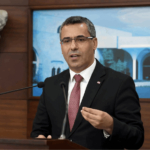
Member of the Loyalty to the Resistance Bloc, MP Hussein Jishi, confirmed that the authority in Lebanon provided the Israeli enemy “what he did not dream of obtaining,” considering that it abandoned the Arab Peace Initiative and the armistice agreement, during the two honoring celebrations held by Hezbollah for the martyrs of the Islamic Resistance in the towns of Siddiqin and Kfardounin.
At the celebration held in the town of Siddiqin in commemoration of the martyrs of the Islamic resistance who rose in the battle of the “Devouring Storm,” Jishi said that the authority in Lebanon, during the course of reaching what he called the “framework agreement” with the Israeli enemy, “was not negotiating as much as it was receiving instructions,” considering that any negotiations required possessing elements of power, while the authority went to the negotiations without any element of power, as he put it.
He added that the Lebanese army, despite its respect for its national faith, lacks the political decision and armament necessary to confront Israel, holding the authority responsible for this, and considering that it criminalized the resistance and abandoned it before going to negotiations, which, according to him, Lebanon lost an element of its strength.
Jishi believed that Israel does not recognize international law or United Nations resolutions, and is supported by the United States, which he said also does not abide by international law, considering that the American, who supplies Israel with weapons, presents himself at the same time as a mediator and arbitrator in the negotiations.
He addressed the Lebanese authority by saying that the state law does not constitute an element of strength in confronting Israel and the United States, adding that the political decision did not allow the Lebanese army to confront Israel, while the resistance was criminalized, wondering about the elements of power that remained with Lebanon in the negotiations.
At the honoring ceremony held by Hezbollah in the town of Kfardounine for the martyrs of the Islamic Resistance, Jishi said that the Lebanese authority had made concessions that even exceeded what was stipulated in the Arab Peace Initiative of 2002, based on the principle of “land for peace,” considering that it had also abandoned the Armistice Agreement of 1949, which regulates the relationship between Lebanon and Israel with regard to borders and attacks.
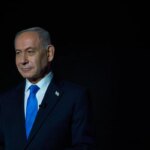
He called on the authority to respond to the statements of Israeli officials regarding the “Framework Agreement,” noting that Israeli Prime Minister Benjamin Netanyahu said that the agreement strengthened Israel’s presence in Lebanon with the approval of the Lebanese authority, calling for an explanation of the benefits that Lebanon gained from this agreement.
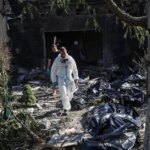
Jishi considered that the authority recognized Israel through direct negotiations, criminalized resistance before the agreement, and granted Israel, as he put it, privileges that it had not dreamed of obtaining. He pointed out that the agreement did not succeed, in his opinion, in bringing about a ceasefire, and that Israel is still carrying out its operations and continues to target the Lebanese and destroy homes.
Jishi concluded by stressing that the American-Israeli project suffered, as he put it, a “major setback” in the last battle, considering that the goals announced regarding ending resistance and redrawing the region were not achieved, and that field facts proved otherwise.