Walid Freiji – Call of the Nation
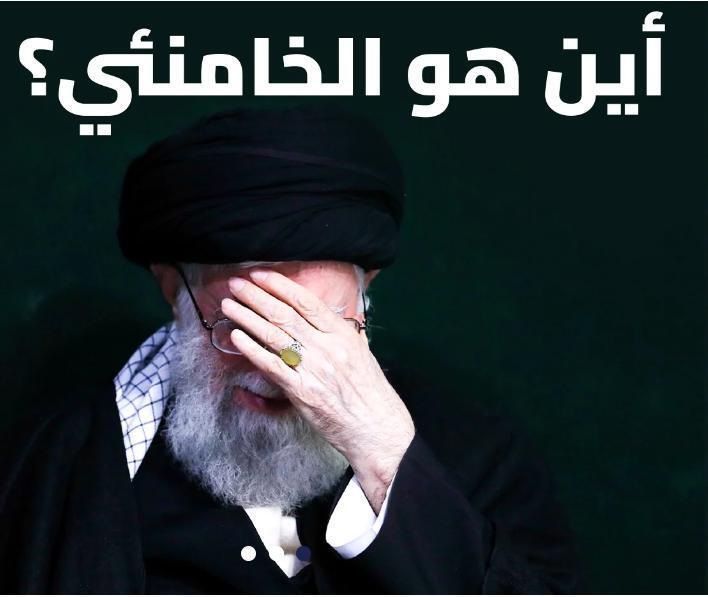
In light of the massive American military movements towards the Middle East that herald the approaching beating of war drums, despite the hesitant and timid signals that have recently emerged from Washington and Tehran, the Iranian regime does not appear to be acting under the impression of an imminent diplomatic breakthrough. Behind the language of negotiation, Tehran operates with a security mind that assumes the worst and places the scenario of open war at the heart of the calculations. At the heart of this approach, the most important question arises: Where would Supreme Leader Ali Khamenei be if war broke out?
The hideout is a doctrine, not a refuge
According to intersecting Western intelligence reports, Khamenei does not rely on a single fixed headquarters in extreme emergency situations, but rather a network of highly fortified bunkers that was established in stages, since the Iran-Iraq war, and developed later with the change in the nature of wars and precision strikes. These bunkers, which are believed to be located in internal mountainous areas far from the borders and coasts, were designed to be beyond the reach of air and missile strikes, and to protect the “head of the regime” from any targeting attempt in the first hours of any comprehensive confrontation.
These sites are not managed as a traditional “command headquarters,” but rather as part of a system of constant camouflage and change, which prevents any site from being established as a fixed target. The hideout, in Iranian doctrine, is not just a precautionary measure, but a structural element in the survival strategy.
In this context, reports indicate that Khamenei is currently in an underground bunker, and sometimes moves between several bunkers connected to a complex and fortified tunnel network, which is said to have also been built to host senior leaders of the Revolutionary Guard and Iranian intelligence. Reports suggest that the bunker is located in the Loyzan area, northeast of Tehran, and that the structure is not just a small bunker, but rather an underground network designed to withstand direct strikes. Reports indicate that the hideout was used during the Iran-Israel war and that Iran transferred Khamenei and his family to it.
Negotiation does not eliminate fortification
It is noteworthy that the escalation of talk about the leader’s hideout coincides with a negotiating path that is supposed to reduce the possibilities of war, despite the American military buildup taking place to strike Iran and the likelihood that zero hour will start within days. However, the Iranian regime does not view negotiation as a safety umbrella, but rather a fragile stage capable of collapsing at any moment. Therefore, Khamenei keeps himself within the “permanent fortification” equation, even as he sends convincing signals of flexibility through diplomatic channels. This apparent contradiction reflects a firm conviction in Tehran: There is no reliable peace before it is tested on the ground, and there are no permanent guarantees in a volatile international system.
Ras Al-Pyramid is a potential target
Politically, the bunker goes beyond its security dimension to carry a deeper meaning. It is an expression of a growing Iranian awareness that targeting the top of the pyramid is no longer a theoretical taboo in any future war, especially in light of the growing debate within Israel and the United States about the feasibility of “strike at the center” instead of just striking the regional arms.
In this context, fortifying the guide becomes a double message: to the inside, that the regime is prepared for the worst and will not collapse with one blow; To the outside world, any bet on quickly paralyzing leadership is a risky bet.
Underground driving
With the entry into force of the ceasefire between Iran and Israel, questions increased within Iran about the absence of the Supreme Leader, who did not appear in public for about two weeks, despite the escalation of events internally and externally. According to the Jerusalem Post newspaper, Khamenei’s absence that day became a source of widespread public concern.
In a television program on the Iranian official channel, the questions were raised publicly. Lieutenant Colonel Mehdi Fazaili, Khamenei’s office director, asked what concerns Iranians: “People are very worried about the leader.” But he did not provide a definitive answer. He simply said: “We must all pray… those responsible for protecting him are doing their duty.”
In this context, the New York Times, citing Iranian officials, revealed that communicating with Khamenei at that time had become extremely difficult, and that messages were being transmitted to him in writing through people, while he was holed up in a hideout that did not contain any electronic communication. This detail, even if it seems technical, reflects the level of concern about hacking, jamming, and cyber targeting, and reveals the extent of the shift in leadership style in times of crises, in contrast to the hideout of the former Secretary-General of Hezbollah, Hassan Nasrallah, which was security breached after he spent his last days inside it underground. It was built with Iranian technology and under the utmost secrecy, and only a few close associates within Hezbollah knew about it.
Reports indicate that Khamenei is not politically isolated, even in the harshest scenarios, as fortified, multi-layered communication networks have been prepared that allow him to communicate with the regime’s inner circle: the National Security Council, the leadership of the Revolutionary Guards, and the Supreme Leader’s Office, in addition to alternative leadership mechanisms that guarantee continuity of decision-making in the event that direct communication is not possible. It was reported that the Supreme Leader delegated the management of the daily affairs of the state to his younger son, Masoud Khamenei, who now manages the Supreme Leader’s office and assumes the role of the primary link with the executive authority, at a level that reflects the extent of anxiety and tension within the government circles in Tehran.
After Soleimani
Western sources confirm that these arrangements were not the result of the moment, but were subject to profound revisions after the assassination of Qassem Soleimani, and what that event revealed of the fragility of some traditional leadership styles in the first moments of shock. Hence, the guide’s hideout and the communication network associated with him formed the nucleus of what could be called the “emergency state” that the regime prepared to remain effective even under bombardment.
Between the diplomatic hatch and the cement walls
Thus, the question about Khamenei’s hiding place turns into a question about the nature of the stage itself. A stage in which negotiations are conducted above ground, while survival calculations are built below it. Between a diplomatic niche that has not yet expanded, and thick cement walls prepared for the worst, Tehran continues to walk on the brink of internecine war.
| The other sideExiled Iranian director Mohsen Makhmalbaf confirms in his documentary film “The Secrets of Khamenei’s Life” that the exaggerated secrecy and opacity that Khamenei adopts in his life did not come out of nowhere, but rather based on the advice of scientists specializing in human psychology and religious societies, and in application of the saying: “He who has no secret has no magic.” Based on the advice of doctors specializing in nutrition, Khamenei eats trout and rashtai caviar from fish, and from birds, the meat of pheasants, quails and ostriches. Because it is free of fat and cholesterol. Khamenei spent $500,000 on purchasing an American-made machine to examine food, which issues a signal if it is poisoned. The number of horses that Khamenei owns is approximately 100, and their price is approximately $40 million, the most expensive of which is his horse known as “The Winged One,” whose value exceeds $7 million. Khamenei loves collecting pipes and owns 200 of them, worth $2 million. And the rings, numbering about 300, unparalleled in the world, and more than 170 “antique” wands, worth about one and a half million dollars, in addition to the abayas, numbering 120, priced at approximately 400 thousand dollars. |
The post Khamenei’s bunker: Secrets and details of the secret buried under Tehran appeared first on 961today Lebanon Today.