Nabil M. Saliba – Call of the Nation
The world is changing, and the global order is being classified based on the power of countries and their economic capacity, leading to a state of instability and short-term chaos among nations. This is due to fundamental shifts in the policies of the most powerful country on Earth: the United States, following the re-election of Donald Trump as president of the country.
Debt, inflation, currency devaluations, wars, conflicts, unrest, economic policies, monetary goals, and greed; All of these factors lead towards a new world order and a new dawn for the United Nations as we knew it in the last century. With this in mind, real and hard assets are back in the spotlight and at the center of the investment landscape.
Table 1: Top 50 assets in the world as at the beginning of 2026
Real assets have reached 100-year lows over the past three to four years. The past four decades have been shaped by low interest rates, globalization, and leverage; These are forces that reward long-term investments and abstract assets. Today, the scene looks different; Financial expansion, fragmentation and geopolitical tensions, as well as supply chain security and resource constraints, have become structural features rather than temporary disruptions.
Such periods tend to develop slowly, then suddenly. The opportunity is rarely obvious at first.
All you need is an insurance deal or covenant: The answer lies in hard assets, i.e. commodities and precious metals in general (other than real estate).
The tremendous rise of gold in the past two years indicates a momentous change in the future of global finance and markets. History confirms that this matter has its implications:
Gold is rarely traded on momentum alone. The dispersion of wild expectations suggests rising risks surrounding real yields, purchasing power of currencies, and policy sustainability.
It also indicates that markets are entering a phase where linear forecasts become less reliable and results become more uniform. Historically, periods of high uncertainty have favored hard assets, with gold often being one of the most prominent ones. For prepared investors, this creates promising opportunities. After all, markets hate uncertainty.
The ratio of gold to silver often indicates peak prices throughout history since the era of ancient Egypt. (Table 1)
The new and majestic uptrend
The approximate annual gold production is about 3,500 metric tons, and that is not counting new gold discoveries and mines or new investments in mines in general.
– Demand from central banks: long-term holdings, with stable purchases. (Table 3), especially from China and India, in addition to Russia and some European countries, where it reached about 1,000 metric tons in 2025 and is still increasing, after the decline in confidence in paper currencies and the US dollar as the main reserve currency.
– Demand for gold ETFs: short- and medium-term, high-volatility holdings, expected to see continued inflows, with estimates ranging from 750 to 900 tons in 2026.
– Physical and investment gold demand: long-term holdings, jewelery demand, stable holdings, is expected to remain strong, especially in emerging markets as well as China and India, where it could reach around 2,100 metric tons.
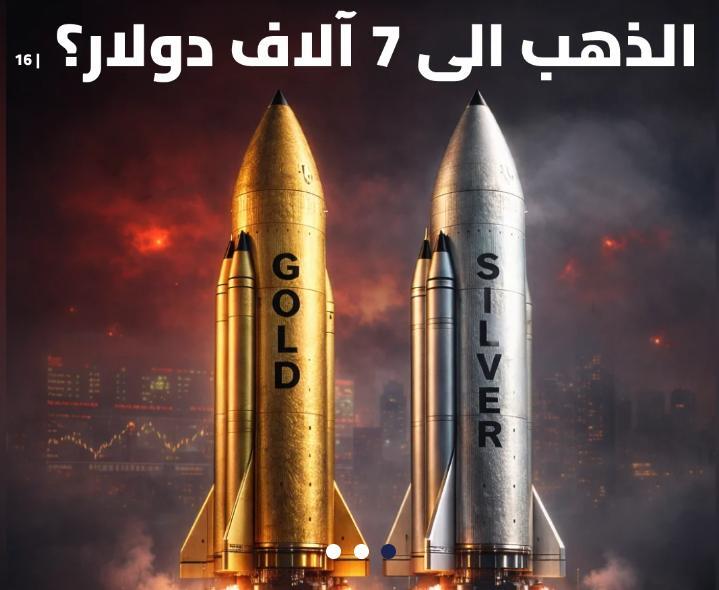
This is without talking about industrial demand. Based on the above, the demand for gold in 2025 reached about 5,002 metric tons. If the expected growth in demand continues at about 15% per year, the expected future price (where demand exceeds supply) will be about $7,000 per ounce within two and a half years. The continued growth in demand, combined with the very important fact of increasing portfolio allocations (from 3% to 15%) to mutual funds, retirement and investment accounts, could be very large ($60 trillion in assets under management).
As Mohamed El-Erian said on CNBC TV in a December 2025 interview, when a new uptrend forms, it attracts speculators or short-term investors, creating a floor for prices but with greater volatility and swings.
The shock price correction on Friday, January 30, for gold and precious metals wiped out about $7 trillion in market value, and provided a painful lesson about risk for speculators and short-term investors. It’s an understandable correction given the magnitude of the exponential increase in a very short period of time. The extent of the decline from a peak of $5,598 per ounce to around $4,500 (a roughly 18% drop) as of Monday morning, February 2, is a matter of profit taking; Thus a liquidity problem arose as everyone wanted to exit at the same time, which exacerbated the situation. It was a historic decline not seen since the 1980s.
However, gold and silver should consolidate and form a base for the continuation of the future uptrend. Additionally, gold is still up 69% from one year ago and its 52-week low is $2,773, and silver is up 152% from one year ago as well and its 52-week low is around $27.97 per ounce.
Silver, which is closely linked to gold, will eventually follow and, with supply and demand imbalanced, is expected to reach $230 per ounce (based on the current value of the dollar compared to the $55 peak in 1980) within two years or even sooner.
In conclusion, it must be said that “The trend is your friend,” so investors in general should adjust their investment portfolios accordingly, and focus on the medium and long term.
The post Gold to 7 thousand dollars appeared first on 961today Lebanon Today.