It is clear that the announcement made by Information Minister Paul Morcos yesterday evening from Kuwait represents a prominent step in terms of connotations, dimensions, and regional and international timing. He revealed that the second phase of the plan to “confine weapons” north of the Litani will be presented to the cabinet table in the coming days, and indicated that the government “does not aim for a confrontation with Hezbollah, but rather to extend state authority.”
It seems that this step is not separate from the tense regional context and international climate, especially American and European pressure, to continue the process of extending state authority over the entire Lebanese territory. This comes with the start of preparations for sending official invitations to the army support conference scheduled to be held on the fifth of next March in Paris, based on the conditions set by countries friendly to Lebanon, which focus on “confining weapons” before providing support to the Lebanese security institutions.
The visit of Army Commander Rudolph Heikal to the Kingdom of Saudi Arabia dealt with military support, while the President of the Republic, Joseph Aoun, reviewed with the Minister of the Interior and Municipalities, Ahmed Al-Hajjar, the ongoing preparations for the conference to support the army and the Internal Security Forces.
On the other hand, Prime Minister Nawaf Salam discussed in the government palace with the Special Coordinator of the United Nations in Lebanon, Jeanine Hennis-Plasschaert, the upcoming Paris conference and the meeting of the “Mechanisms” Committee this month, in addition to the post-UNIFIL phase. Plasschaert also presented these addresses with Foreign Minister Youssef Raji.
Regarding the electoral eligibility, 48 hours after the opening of nominations, a noticeable absence of candidates in the Ministry of Interior was noted yesterday, while ambiguity surrounds the electoral law regarding the items related to expatriate ballots, the megacentre, and the magnetic card. Insiders reported that the President of the Republic strongly rejects any postponement of the elections and also opposes any violation or transgression of laws and constitutional entitlements.
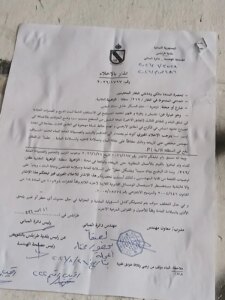
In Tripoli, the political and popular movement continues to contain the repercussions of the disaster of the collapse of the Ain al-Tabbaneh building last Sunday, coinciding with the evacuation of the crumbling buildings. The President of the Republic presented with the Minister of Interior, Ahmed Al-Hajjar, the measures taken by the government at all levels to confront the crisis of hundreds of buildings threatened with collapse and to provide shelter for hundreds of families.
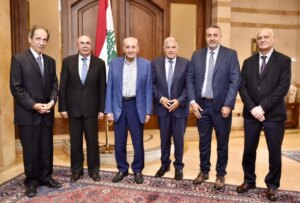
Minister of Social Affairs, Haneen Al-Sayed, visited the city to follow up on field procedures, while Speaker of the House of Representatives, Nabih Berri, received a spiritual delegation from Tripoli in Ain Al-Tineh. The Mufti of Tripoli and the North, Sheikh Muhammad Imam, confirmed after the meeting that the disaster is great and requires concerted official, societal and expatriate efforts.
Judicially, the indictment panel, headed by Judge Elias Eid, ratified the decision to prevent the trial issued by Judge Habib Rizkallah against the judicial investigator in the Beirut port explosion, Tariq Al-Bitar. The Authority rejected the appeal request submitted by former Director General of Customs Badri Daher in form, while it accepted the request of former Minister Ali Hassan Khalil in form and rejected it in principle.
In the south, Israeli bombing operations continued, and citizens spoke of an Israeli force incursion towards Tallet Shawat and that Israeli forces carried out two bombings in the village of Al-Adisa in the evening, while a joint patrol from the Lebanese Army and UNIFIL was also recorded to inspect an Israeli tank’s violation of the Blue Line on the outskirts of Yaroun.