November 13, 2026

The exceptional political situation in Israel led to an unusual division of power between two competing camps, after the 26 members of the Knesset were sworn in, and the elections ended without the formation of a new government. Which divided the legislative and executive powers between two opposite parties, according to a report published by journalist Amir Ettinger on the “Yedioth Ahronoth – Ynet” website today, Friday.
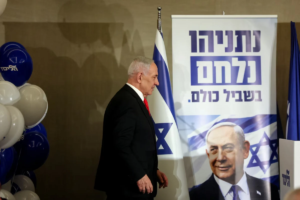
Prime Minister Benjamin Netanyahu retains the presidency of the government and the management of the security establishment and ministries, but remains bound by legal controls imposed on caretaker governments. On the other hand, the change camp, led by Gadi Eisenkot, controls the parliamentary majority, which gives it the ability to disrupt government steps and control sensitive legislative, financial, and security paths, in a scene that raises questions about the limits of each party’s powers in light of the ongoing disagreements regarding dealing with Iran.
Control of the Knesset is of great importance in determining priorities for legislative work, forming committees, and accelerating or delaying financial approvals. In the first test of the balance of power, the Eisenkot camp achieved a parliamentary victory by approving the formation of the organizing committee headed by Representative Roi Volkman, which is the committee responsible for presenting the permanent committees and establishing temporary committees, such as the Finance Committee and the Foreign Affairs and Security Committee. Despite the continued presence of Amir Ohana (from the Likud Party) at the head of the Knesset and his imposition of postponing committee meetings until next Monday, the Eisenkot camp is counting on the vote scheduled for Tuesday to replace him with candidate Matan Kahane, with the aim of tightening control over the basic aspects of Parliament.
The camp seeks at a later stage to establish temporary committees to repeal laws related to what is known as the “judicial revolution,” which includes amending the composition of the judges’ selection committee, the police investigation unit law, legislation to weaken the government’s legal advisor, and the communications law.
On the financial level, the Netanyahu government will face real obstacles in passing financial transfers through the Finance Committee headed by Liran Abichar Ben Hourin, in which the Change camp has the majority. Unlike previous years, which made it easier to pass amendment requests and transfer surpluses, the new committee will be able to block requests or request additional details; Especially with the possibility of moving to work with a temporary budget next January if a new budget is not approved. The appointment of Abichar Ben Hourin sparked political controversy and criticism from the right due to conflict of interest concerns related to her husband’s consulting work.
In the security field, control over the Foreign Affairs and Security Committee – whose chairmanship was transferred to Avigdor Lieberman – allows for broad parliamentary oversight of the army, the Shin Bet, and the Mossad. Lieberman announced his intention to summon Shin Bet head David Zinni and Police Commissioner Danny Levy to discuss suspicions of foreign interference in the elections, in addition to discussing the existing dispute between the army and Netanyahu regarding Iran.
On the other hand, Netanyahu’s government ministers continue to manage state affairs, but the government’s legal advisor, Gali Beharav Meara, obligated the caretaker government to exercise restraint, adhere to strict limits, and attach every draft decision to a legal opinion and prior consultation if the decisions go beyond the normal administration.
These data reflect a complex political reality that Israel finds itself facing. A prime minister administers executive and security decisions without a parliamentary majority, and an opposition camp controls the tools of legislation and financial and security oversight without executive authority, so that the conflict turns from merely forming a government into a battle for comprehensive control over decisions and budgets before deciding the identity of the next authority.