October 5, 2026

Muhammad Shuqair – Asharq Al-Awsat
Lebanon fears that the Lebanese-Israeli military meeting, under American auspices in Florida on October 20, will constitute a stop to pass the time until the Knesset elections are held in Israel on the 27th, and the “American midterms” on the third of next November, relying on American intervention to activate the implementation of the “Framework Agreement.”
Lebanon is afraid of being involved in managing the crisis to fill the void, and is seeking, through its military delegation to the Florida negotiations, to create a breach that opens the door to continuing the implementation of the “Framework Agreement,” which is a point of intersection between Prime Minister Nawaf Salam and US Secretary of State Marco Rubio in their meeting in Washington, instead of the meeting being a station that Washington is looking forward to to pass a message that it is continuing to sponsor the negotiations regardless of the results that the negotiators may reach.
Fill the void with minimal damage
In this context, a Lebanese source concerned with the negotiations said that filling the void with wasted time with minimal damage requires reducing the level of internal tension and preventing Israel from expanding the security zone so that Lebanon can withstand keeping the negotiations dependent on the election results in Israel. He confirmed to Asharq Al-Awsat that contacts are ongoing between Beirut and Washington to fix the deadline for holding the military meeting, which is headed by the Lebanese side, the head of the negotiating delegation, former Ambassador Simon Karam, in the presence of Ambassador Nada Hamada Moawad, and the Director of Operations at the Army Command, Brigadier General George Rizkallah, who heads the military team.
The source pointed out that the Lebanese delegation to Florida is betting on American intervention to bring the negotiations out of their eighth round of stagnation, and he proposes including the release of Lebanese prisoners held by Israel, and resolving the controversy surrounding the formation of a “verification mechanism” for the deployment of the Lebanese army in the “experimental zone,” after expanding it and ensuring that it is free of Hezbollah weapons and its fighters, and establishing a ceasefire, on the meeting’s agenda.
He believed that removing the “verification mechanism” from the tensions requires agreement on its role and on who heads it, in addition to providing guarantees that the team of observers emanating from it will not be harmed. This is what is required of Israel and Hezbollah, which continues its campaign against direct negotiations, insists on keeping its weapons, and demands dropping the “framework agreement” and linking the Lebanese track to Iran with its proof of the Iranian-American “memorandum of understanding” as an alternative to the agreement despite Washington’s rejection of that.
Fears of expanding the war
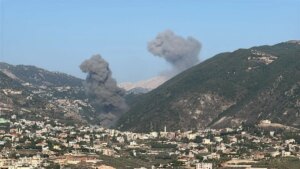
The source confirmed that Lebanon fears that Israeli Prime Minister Benjamin Netanyahu will resort to expanding the security zone by targeting the heights located between Iqlim al-Tuffah and Jabal al-Rayhan, and hopes that Washington will intervene to control the performance of the Israeli army, even though Tel Aviv’s withdrawal of combat units, meaning those belonging to the Golani Brigade, means from the military point of view that it has no intention of attacking with the aim of expanding to the extent that it continues to close in on the security zone by bulldozing towns and destroying what remains of the homes in it, and it is now in A defensive position to prevent Hezbollah fighters from infiltrating it, in exchange for its control of the towns located on the front edge north of the Litani River overlooking its south, turning them into scorched earth, similar to what happened to the towns located within the Yellow Line.
But the source is not reassured that Netanyahu will not deviate if he is forced to raise his level of support in the elections to ensure his return to head the government.