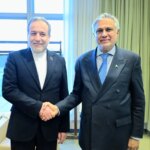
Pakistan renewed its call to give priority to the path of dialogue and diplomacy to resolve the differences and conflict existing between the United States and Iran. This came during a meeting between Pakistani Deputy Prime Minister and Foreign Minister, Muhammad Ishaq Dar, with his Iranian counterpart, Abbas Araghchi, on the sidelines of the 81st session of the United Nations General Assembly in New York.
A statement issued by the Pakistani Ministry of Foreign Affairs on Thursday stated that the two sides discussed bilateral relations and exchanged views on regional and international developments. The Pakistani minister stressed the centrality of ongoing dialogue and communication to consolidate peace and stability in the region, and the two ministers agreed to keep communication channels open and continue joint coordination.
This meeting comes after talks held by the Iranian delegation, headed by Araqchi, on Wednesday in New York, through a Qatari mediator, with the American envoy Steve Witkoff and Jared Kushner, the son-in-law of US President Donald Trump, in the first round of negotiations between the two sides in months, which did not result – according to indications – in any concessions in the declared positions of the two parties regarding ending the war in the Middle East.
In the same context, Reuters quoted a senior Iranian official – who preferred to remain anonymous – that Tehran is studying the American response to its peace proposals, which put at the top of its priorities the lifting of the American naval blockade imposed on Iranian ports and the reopening of the Strait of Hormuz, stressing the continuation of diplomatic efforts despite the remaining fundamental differences between the two parties.
On the American side, Secretary of State Marco Rubio said on Wednesday that reaching an agreement with Iran takes time and requires hard effort, noting that President Trump also maintains military options.
It is noteworthy that Washington had announced its intention to impose secondary sanctions on any country that allows Iranian flights, starting on Wednesday. In a direct reaction, the Secretary-General of the Iranian Supreme National Security Council, Mohsen Rezaei, warned on state television that his country would ensure that the airports of neighboring countries were disrupted if Iranian flights were stopped.