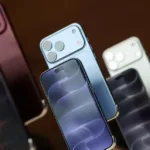
The first disassembly of the iPhone 18 Pro, which was published by REWA Technology, a company specialized in repair, on September 18, coinciding with the launch of the device for sale, according to the “Frandroid” website, revealed radical changes in the internal design, accompanied by improvements in performance and cooling, but it came at the expense of ease of repair, which may make maintenance operations more complex and expensive.
In the most prominent visual and technical changes, Apple has placed the infrared camera for the facial recognition system (Face ID) at the bottom of the screen in the upper left corner behind a pattern of pixels that pass the rays. This design reduced the size of the Dynamic Island feature, but in turn increased the complexity of manufacturing compatible replacement displays, posing a challenge for independent repair shops.
In terms of thermal performance, Apple has made extensive modifications to the cooling system. The A20 Pro chip is now adjacent to a vapor chamber to distribute heat, with an area approximately three times that of its counterpart in the previous generation, and is connected to the system via a thermal pad. This design contributes to improving heat management under high pressure, such as gaming and video editing, and tests show that the phone outperforms some gaming phones in temperatures.
In contrast, the denser design of components made repair more difficult; The NAND memory and power management circuit (PMIC) have become sandwiched between the layers of the motherboard, requiring them to be separated one by one in a delicate process that risks damaging components. The presence of an exposed EEPROM chip on the surface of the motherboard increases the possibility of components being damaged during maintenance.
These transformations reflect Apple’s direction towards increasing performance and compressing components into a limited space. The resolution of the main camera has been increased to 48 megapixels, with the addition of a variable lens aperture that requires a wider area for the optical unit. In the same context, the battery capacity in the European version with a SIM tray was about 4056 mAh, compared to 3988 mAh in the similar “iPhone 17 Pro” model, an increase of about 1.7%, while the enlargement of the battery connector indicates the possibility of supporting higher charging speeds that have not yet been confirmed.
In summary, the “iPhone 18 Pro” embodies a design paradox that is evident in qualitative leaps in cooling, performance, and component density, matched by increased complications in accessing and maintaining internal parts, which is directly reflected in the cost and duration of repair outside Apple’s authorized centers.