Minister of Public Works and Transport, Fayez Rasamny, at the head of a Lebanese delegation, conducted an official visit to Syria, devoted to discussing strengthening cooperation between the two countries in the transport sector, especially land and railway transport, and developing connectivity in a way that facilitates the movement of passengers and goods, stimulates trade exchange and enhances regional logistical integration.
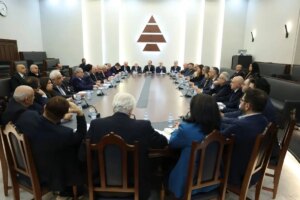
The Syrian Minister of Transport, Yarab Badr, received Rasamny and the Lebanese delegation upon their arrival to the Ministry’s headquarters, where an official reception was held, followed by an expanded meeting between the two delegations, headed by the two ministers.
The meeting dealt with reactivating the railway connection between Lebanon and Syria, developing land crossings, facilitating the movement of transport and trade, and the prospects for building an interconnected network linking Lebanon to the countries of the region.
The Lebanese delegation included Advisor to the Prime Minister, Sati Arnaout, Advisor to the Deputy Prime Minister, Samer Haddara, Chairman of the Board of Directors, Director General of the Railways and Combined Transport Authority, Ziad Shea, Director of the Port of Tripoli, Ahmed Tamer, Rami Khoury, Technical Advisory Engineer for the railway project between Tripoli and Al-Aboudiyah, and Advisor to the Minister of Public Works and Transport, Duraid Abu Said.
During the meeting, Rasamny stressed the importance of transferring cooperation in the transportation sector to a practical path based on common interests, which contributes to developing Lebanon’s logistical options and enhancing its ability to access regional markets.
He explained that the focus is on reactivating and developing the railway connection between Lebanon and Syria, especially from the port of Tripoli through Aboudia, all the way to the Syrian railway network, and from there to the countries of the region.
He pointed out that developing this route would provide more effective transportation options, reduce its cost, and open broader horizons for Lebanon and its ports in the fields of trade and transit.
Rasamny pointed out that the vision goes beyond bilateral connectivity towards a broader regional path that allows Lebanon to be connected, through the Syrian network, to Iraq, Jordan, the Gulf states and Turkey, and to benefit from its location and ports on the eastern Mediterranean to serve regional trade.
He stressed that the goal is to support economic growth, enhance export and import movement, reduce transportation costs, and create new opportunities for the Lebanese economy.
For his part, Badr stressed the importance of reactivating the railway connection between Syria and Lebanon, pointing out that it is not a new project, but rather based on a historical reality in which the Syrian and Lebanese railway networks were interconnected.
He stressed the importance of reviving this connection within a more comprehensive vision for regional transport networks, explaining that the Syrian railway network allows, after rehabilitating the necessary sections, the development of the connection with Lebanon and a number of neighboring countries, thus opening a land and rail path linking the eastern Mediterranean to regional and Gulf markets.
The two sides agreed to form a joint Lebanese-Syrian technical team of specialists, which will, in the coming weeks, follow up on the files that were discussed, study the options and technical paths required to reactivate the connection between the two networks, and update previous studies in a manner consistent with current data, expected transport movement, and implementation requirements.
On the Lebanese side, the team is headed by the Chairman of the Board of Directors and Director General of the Railways and Joint Transport Authority, Ziad Chia, and on the Syrian side, the Assistant Minister of Transport for Land Transport Affairs, Muhammad Rahal.
The meeting also discussed the railway link project between the port of Tripoli and the Syrian border through Al-Aboudiyah and reaching Homs, as it is one of the basic projects that can be built upon to connect the port to the regional railway network.
The two sides discussed the conditions of the land crossings and ways to develop them and facilitate the crossing movement, as Rasamni announced that the Al-Aboudi crossing is heading to reopen within about a week, which will contribute to reducing pressure and congestion on the other crossings.
The research also addressed the Masnaa Crossing development project and the requirements for securing the necessary funding for its implementation.
Following the meeting, Rasamny and Badr held a joint press conference, during which they presented the most prominent discussions and results they reached, especially the agreement to launch joint technical follow-up to the railway connection file and transfer the proposed addresses.
into followable implementation steps.
Rasamny stressed that Lebanon is looking forward to taking advantage of its location, ports, and regional transportation networks to build more effective paths towards Arab markets, stressing that the ambition goes beyond linking two countries to building an interconnected regional transportation network that supports trade and economic growth.
In turn, Badr stressed that the joint work between the technical teams in the two countries reflects a serious will to move forward with reactivating the railway connection, stressing the importance of building on the results and following them up at the technical level to move to practical steps.
The two ministers stressed that developing land and railway connectivity and modernizing transportation infrastructure constitute an essential element in strengthening economic relations, facilitating the movement of people and goods, reducing the cost of trade and transportation, and expanding options for exporters and importers in the two countries.
At the conclusion of the official program, Rasamny and the Lebanese delegation, accompanied by the Syrian side, moved to the historic Hejaz Station in Damascus, where they toured around it and learned about its historical and archaeological value related to the history of the railways.
Railroad and transportation in the region.