The “Al -Jazeera” website in English published a new analysis, through which it posed a basic question, which is the following: “How does the Lebanese Hezbollah return its ranks after the war with Israel?”
The analysis translated by “Lebanon 24” says that “a year after the assassination of Israel to Hezbollah Secretary -General Hassan Nasrallah, reports say that the party is reorganizing its ranks.” He added: “Analysts believe that while the weak Hezbollah is no longer able to form a major threat to Israel, it is still able to create chaos and challenge the opponents locally in its attempt to find a political foothold to preserve. His influence. ”
He continued: “After Hezbollah was seen for a long time as the strongest non -governmental armed actor in the region, his star found a decline last year, which led to an international and local push to fully remove his weapon. Likewise, analysts believe that if the pressure is treated to disarm the group recklessly, it may lead to a violent reaction and fabricate an internal conflict that may exceed international and regional pressure.”
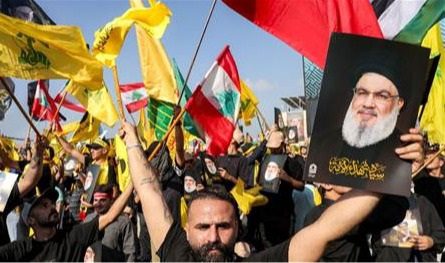
He continued: “But Hizbul: Hezbollah is still challenging in his speech, and he promised to reject the efforts of the Lebanese government to remove his weapon. His current Secretary Naim Qassem affirmed on Saturday in front of a crowd of thousands of people who gathered at the shrine of a text. God God to commemorate his assassination.”
He added: “Hezbollah began to exchange attacks with Israel on October 8, 2023, that is, a day after the latter launched its war on Gaza, and this continued until September 2024, when Israel’s intensification of the military and the subsequent invasion led to the killing of 4,000 people in Lebanon, the injury of thousands, and the displacement of hundreds of thousands,” says the report.
By the time when the ceasefire was announced on November 27, most of the major military commanders of Hezbollah, including Nasrallah, were assassinated by Israel.
The report quotes diplomatic sources on the ceasefire agreement that “the conditions of the latter were mysterious, but the general understanding was that the two sides (Hezbollah and Israel) will stop the attacks, and that Hizbullah will remove its weapon in southern Lebanon, and that Israel will withdraw its forces from the south.
He continued: “After the local and regional opponents of Hizbullah noticed his weakness, they began to ask him to abandon his weapon. As many of the local Hizbullah allies sensed the winds of the area, the winds of the area were fully and announced their support to completely remove his weapon.”
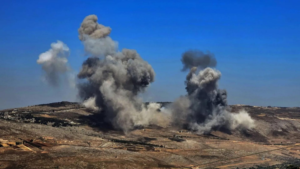
The report stated that “on September 5, the Lebanese government announced that the Lebanese Armed Forces mandated a plan to disarm Hizbullah.” He added: “Meanwhile, Israel continued to violate the ceasefire, by bombing it in southern Lebanon. Also, the United Nations Temporary Force in Lebanon (UNIFIL) in the south stated that Israel is committing continuous violations of the ceasefire agreement, including air strikes and air strikes on the air strikes and air strikes on the air strikes and air strikes on the air strikes and air strikes at Lebanese lands.
He continued: “Despite the media speculation that Hizbullah reorganizes its ranks in southern Lebanon, especially in the media hostile to Hezbollah, it has only claimed responsibility for one attack since the ceasefire in November.”
He added: “Analysts believe that Hizbullah is no longer in a situation that allows it to threaten Israel, which means that any decision by the latter to expand its attacks in Lebanon will be due to other considerations other than the capabilities of Hizbullah. Hezbollah. Likewise, Hezbollah and its supporters find that the threats of Israel and its continuous breaches, as well as the continued occupying existence of five points on Lebanese lands, justifies the need.”
“No military or political force will be able to reorganize its ranks after suffering a great defeat, as happened with Hizbullah last year.”
As for the report, he asks here: “But are they (i.e. Hezbollah) in a situation that allows them to launch rockets and bombed northern Israel along the border?” .. The answer presented by the report is: “No” ..
In addition, the report quotes the Lebanese political researcher Imad Salama as saying that “Hizbullah is significantly exhausted.
Salama stated that “the Israeli assessments themselves indicate the damage and attempts of Hezbollah to renew through smuggling/self -production under intense intelligence pressure, which indicates that any recovery will be partial and tactical and not structurally in the near term.”
The report says that “in early December, the Hezbollah ally, Bashar al -Assad, was overthrown in Syria, in another blow to the group, where a direct land road was cut off for weapons and financing for Hezbollah.” He added: “In the meantime, analysts said that Hizbullah is trying to use its remaining influence through diplomacy, so that he sent references to its old opponents like Saudi Arabia.”
Here, analysts said that the message addressed to Saudi Arabia is part of a shift in the party’s strategy, while Yong notes that “there is a hint that the party feels its ability to deal with matters politically.”
For their part, analysts and diplomats say through the “Al -Jazeera” that “Hezbollah is still able to stir tensions but avoid fueling any fire due to the increasing support of the Lebanese state as well as the fatigue and the shock of members of Hizbullah and its supporters due to the war last year and the ongoing Israeli attacks on Lebanon.”
For his part, a large Western diplomat said that “if Hezbollah is seeking to reorganize its military ranks, it is likely that this will be done in the Bekaa and not in the south, where the ceasefire mechanism was largely effective in overseeing the withdrawal of Hezbollah.”
As for Young, he said that “the group seems to change its political strategy,” adding that “Hizbullah, based on instructions from Iran, may eventually search for some settlements.”
Nevertheless, the concerns of diplomats and analysts are that the confrontation between the army and Hezbollah may lead to an internal conflict and a potential disintegration of the army on sectarian foundations – similar to what happened in the early days of the Lebanese Civil War between 1975 and 1990.
In his speech, Young told Al -Jazeera: “The disarmament of Hizbullah by force is the worst possible choice, but it is clear that this is the way the Americans are increasingly pressing the Lebanese government to solve this problem.”
He concluded: “The Lebanese army is not ready to solve this issue by using force because it does not want to have to enter into a conflict with Hizbullah.”
Source:
Translated by “Lebanon 24”
Related topics
The post On the recovery of Hizbullah militarily .. What did a new report say? appeared first on 961 tobay Lebanon today.