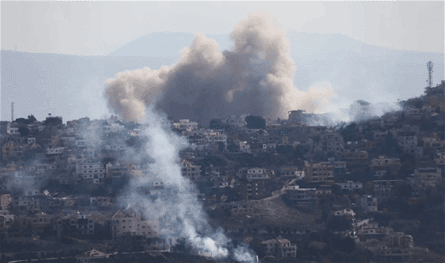
South Lebanon yesterday witnessed a new Israeli escalation that brought tension to the fore, after warplanes targeted four civilian buildings after a series of warnings directed to the population.
This development has sparked many question marks about its backgrounds and timing, especially since it was accompanied by the continuation of the military operations in Gaza, which opens the door for multiple readings of Israeli targets.
The first reason that is offered strongly related to the return of a good section of the border villages to their towns after months of displacement. This scene clearly worried Israel, as the previous strikes against the villages did not prevent the people from returning, which was a real dilemma in front of the Israeli military establishment. Hence, it seems that the warnings preceded by raids are nothing but an attempt to create a state of psychological terror and pressure civilians to push them again to leave their homes, thus keeping the border in a state of human vacuum that Tel Aviv considers safer for them. The second reason is related to the occupancy process of Hezbollah and keeping it in the constant pressure circle. Through these raids, Israel seeks to send clear messages to the party, and to deplete its security and military when it has the opportunity. With each targeting, Tel Aviv opens the possibility of striking sites or capabilities that may be discovered during the past days, within a tactical framework aimed at preventing the party from restoring or restoring the capabilities it lost, in light of its preoccupation with the follow -up of developments in Gaza. As for the third reason, it is political with distinction, as this escalation cannot be separated from the increasing American pressure on Lebanon. Washington, which is preparing to intensify its endeavors in the next stage regarding the weapon file, finds in the Israeli escalation a means of indirect pressure on the Lebanese interior. The continuation of raids and threats enhances the internal debate about the future of weapons in the hands of informal forces, and places political forces in front of a new test, especially in light of the economic and political complications in the country. It can be said that the last raids are not just a separate military action, but rather are part of an integrated strategy through which Israel seeks to achieve more than one goal at the same time: the population is scared to impose field facts on the border, keep Hizbullah under pressure and attrition, and send political messages in harmony with an American agenda wider towards Lebanon. These elements combined explain the nature of the escalation that took place yesterday, and reveals that the south is still an open square in front of mutual messages that go beyond the field framework to interfere in regional and international policy accounts.
The post Israeli escalation: 3 many reasons and goals appeared first on 961 tobay Lebanon today.