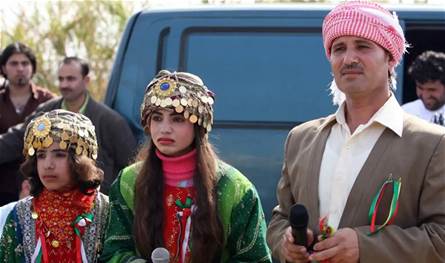
The “Arab Television” website published a lengthy new report in which he spoke about the history of the Kurds in Lebanon and their historical extension, revealing that the Kurdish presence in Lebanon has roots dating back to centuries.
The report reveals that the presence of the Kurds in Lebanon represents one of the aspects of population diversity in the country, noting that “the roots of the presence of the Kurds belong to the Ayyubid era in the 12th century, when this presence was established with the arrival of Salah al -Din al -Ayyubi to the East.”
In the context, Hanan Othman, Vice -President of the Cultural Cultural Association of Kurds in Lebanon, says in an interview with “Arab TV”, that the beginnings of the Kurdish presence in the Arab East, including Lebanon, were linked to Salah al -Din al -Ayyubi, who established the Ayyubid state after its victory over the Crusaders, based on the princes and military leaders of Kurdish origin.
The report says that “the Kurdish presence is strengthened during the Ottoman era, as the Sultanate relied on some Kurdish families to secure the outskirts of northern and internal Lebanon, within the policy of strategic localization.”
As the Ottomans entered the Levant, Kurdish groups were transferred to Lebanon as part of the policy of “military -administrative – administrative settlement”, so they settled in the following areas:
Mount Lebanon (Chouf – Al -Matn)
Bekaa in eastern Lebanon (Rashaya – Baalbek)
– The capital, Beirut, and in a limited way
The report also says that “with the beginning of the twentieth century, Lebanon witnessed new Kurdish immigration waves from Turkey, Syria and Iraq, as a result of political persecution, so the Kurdish identity began to take a clearer cultural and social nature, despite its surrounding the legal and political marginalization.”
Lebanese families of Kurdish origin
Historical details reveal that there are Lebanese families known today and with great influence, whose origins are back to the Kurds.
The most prominent of these families is Al Jumblatt, who was stationed in the Chouf, and their name is believed to be derived from “Janolad” (or Jean Buld), and he is one of the Kurdish leaders in the Ottoman era, and its name means “steel heart”.
There is also the Al -Shamdin family in Tripoli and Akkar, whose origins date back to the Smazin region in Kurdistan, Türkiye, and they settled in northern Lebanon during the eighteenth century. The Abdul Karim family is also one of the families of Kurdish origin, and it has settled in Hermel – Baalbek, and there are accounts that some of its branches arrived during the Ottoman era.
As for the Assi family, they settled in Rashaya – the western Bekaa, who are from the Kurdish families who merged into the Druze or Sunni fabric. Other families such as Al -Hussein, Al -Othman (Tripoli – Al -Minya), Al -Mashik, and the diet (Bekaa) are also Kurdish roots.
Also, many of these families merged into the Lebanese sectarian structure (Sunni, Shiite, Druze), which led to the change of identity over time. However, the accounts of the elderly, especially in Akkar and the Bekaa, still preserve the Kurdish origins of these families, in the absence of official records.
Marginalization
In her speech, Othman noted that despite their primary presence in Lebanon, the Kurds remained outside the official political identity of Lebanon, and they were exposed to multiple forms of marginalization and discrimination, and they were deprived of nationality, and she adds: “Until today, a large number of Kurds are still registered or without identification papers, which deprives them of the simplest rights such as official education, legal work, and possession.”
Actually, the Kurds remained without any official representation in the Lebanese state, not in Parliament, nor in the municipalities, nor even within the quotas of minorities. Despite their participation in economic and social life, they were not treated as a recognized component, but were often placed in the category of “expatriates”, “workers”, or “refugees”, even after generations of residence.
The report also notes that in the mid -nineties of the last century, more than 20% of the Kurds had not obtained citizenship, while about 10% of them were without any papers, and 70% had “under study” cards. In 1994, with the approval of a naturalization decree, 18,000 Kurds benefited from it and obtained Lebanese citizenship.
Where is the Kurds from the Lebanese civil war?
The report also stopped putting the Kurds of Lebanon during the Civil War (19751990), and he said that the aforementioned group did not participate in the fighting formally or publicly, and had no military force. However, Othman says that this does not negate the participation of some Kurdish elements individually, along with the Palestinian factions and Lebanese left -wing parties, especially in Beirut, Bekaa and the South.
Othman explains that the Kurds had no independent military formation, but they were involved, individually and collectively, within the “Makhqaqat Forces” in Lebanon, driven by social marginalization, and the struggle intersection with national issues.
Their participation in the defense of Lebanon was clearly highlighted against the Israeli invasion in 1982, where they were victims in several battles, most notably the battle of Al -Shaqif Castle in the south, in which they fought alongside the “Al -Maqqa factions” until the last minute.
According to Othman, “at least 17 martyrs fell to them during that battle, in addition to wounded and missing in other locations.” (Arab TV)
The post Exciting facts about the origins of the Jumblatt family and the Kurds of Lebanon .. History speaks appeared first on 961 tobay Lebanon today.