Globally… billions are accumulating
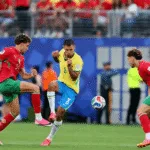
Globally, estimates by specialized institutions indicate that the sports betting market has reached approximately $100.9 billion, and football remains the most important game within this market, because it is the most widespread and most capable of attracting a cross-border audience. In the World Cup in particular, the volume of activity increases due to the intensity of matches, time differences, intensity of follow-up, and the interaction of the average fan with the user looking for a quick bet.
In the 2022 Qatar World Cup, the American Gaming Association estimated that 20.5 million adults in the United States alone planned to bet about $1.8 billion on the tournament. 48 percent of them said they would place their bets online, and 20 percent through informal bettors. These numbers do not include the major markets in Europe, Asia and Latin America, nor do they include the illegal market, which is difficult to measure accurately. And here the problem begins. The legal market is only part of the picture. According to the United Nations Office on Drugs and Crime, the value of illegal betting globally ranges between $340 billion and $1.7 trillion annually, with estimates of about $140 billion being laundered through sports betting each year. As for Interpol, in its recent operations, it has linked illegal betting to cross-border money laundering and fraud networks, including networks that use fake accounts, electronic wallets, and servers distributed in more than one country.
The World Cup, in this sense, is not only a sporting season. It is also a financial and security season. In regulated markets, large companies operate under local licences, and are subject to financial oversight and identity verification rules. In unregulated markets, betting moves to external sites, closed pages, messaging applications, local intermediaries, and frequent small money transfers that are difficult to track if not carefully monitored.
In Lebanon.. the Internet broke taboos
In Lebanon, the issue takes on a different dimension. The country is not a large regulated market like Britain or the US. The local legal framework is practically based on restricting gambling games to licensed institutions, with a clear role for the Ministry of Finance in this field. But the Internet has broken traditional boundaries. The user in Lebanon can access sites based outside the country, some of which are licensed in another country, and some of which operate without actual oversight, while accounts and transfers are sometimes managed through local intermediaries.
There are no official published figures revealing the volume of electronic betting in Lebanon during the World Cup. However, according to a security source who confirmed to “Lebanon 24”, the security forces continue to warn citizens against providing their personal accounts to illegal electronic betting and gambling platforms, after the Anti-Gambling Bureau found that platforms managed from outside Lebanese territory are using these accounts for illegal activities.
According to the source, this warning is important because it explains how part of the market works. The platform may be located abroad, but financial movement requires a local account, an intermediary, or a user who places his account at the network’s disposal in exchange for a commission. Then the issue no longer remains just an individual bet on a match, but rather turns into the possibility of using people’s accounts for suspicious transfers, money laundering, or concealing the source of funds.
According to the source, the competent security authorities arrested one of the most prominent managers of online gambling and illegal betting networks, after uncovering a network whose activities extended into northern Lebanon and Hermel. According to the source, members of the network were arrested and phones, computers, and electronic tools used in its management were seized.
In a related context, the Anti-Gambling Bureau uncovered a network linked to “Paroli” games, manipulating the results of horse races, and practicing illegal betting over the Internet. What was striking was not only the number of suspects, but also the freezing of accounts with money transfer companies that were used in illegal betting and gambling operations. Here comes the intersection between betting, cash, and quick transfers.
Cafes… for simple bets
In cafés and among groups of friends, betting takes a simpler form. A bet on the outcome of a match, a small sum between two people, or participation in a “group” that predicts winners and scorers. But the danger begins when the matter moves from this social framework to unknown platforms, which request personal accounts, identity photos, or frequent transfers, or link the user to an intermediary who does not know who he is working for. The World Cup increases this danger because the psychological pressure and public outburst are higher. The matches are successive, the results are unpredictable, and the user feels that he can compensate for the loss of a match with a new bet in the next match. This is what platforms benefit from. It does not bet on the user’s knowledge of football, but rather on the frequency of his entry, speed, and his feeling that profit is always close.
The persecutions do not stop
The security source indicated to “Lebanon 24” that, security-wise, the treatment in Lebanon is moving on more than one level: persecuting local networks, seizing devices, freezing transfer accounts, and warning against external platforms. But the challenge remains in the cross-border nature of these sites. Closing a link does not always mean closing the network. Another link, a new name, a closed channel, or an alternative application may appear. Therefore, the battle appears closer to a continuous persecution and not to a single strike that ends the market.
The financial aspect is no less important. When sites operate from outside Lebanon and target Lebanese users, the money escapes local oversight. No clear taxes, no user protection, no entity to check for fraud, and no guarantee that funds are not passing into wider networks.
What does the law say?
In the legal framework, a legal source explained to “Lebanon 24” that Lebanese law treats betting and gambling as prohibited activities as a general rule, and only permits them within specific and licensed scopes, such as the Casino du Liban, some horse racing activities, and the official lottery. The source indicates that any website or application that allows electronic betting on matches or international events for residents of Lebanon, without an explicit license from the state, is in principle considered an illegal activity. Criminally.
The source explains that the Penal Code criminalizes organizing or investing in prohibited gambling games, whether they take place in a public place or in a private house designated for this purpose, with penalties that include imprisonment, a fine, and the possibility of closure and confiscation. As for electronic betting, according to the source, there is not yet a special Lebanese legal framework that regulates this type of activity as in some countries, which means that these platforms are evaluated according to the general rules related to gambling and prohibited gambling.
The source adds that the problem becomes more complicated when the main platform is abroad, because the issue of jurisdiction and prosecution requires proof of an actual connection to Lebanon. However, whenever there is a local element, such as an agent, office, accounts for collecting money, organized transfers, advertising directed to the Lebanese, or shipping and sales points operating on behalf of an external site, the possibility of applying Lebanese law becomes greater, and those in charge of this structure can then be prosecuted as organizers of unlicensed gambling activity.
The source points out that responsibility is not limited only to the party that manages the site or application, but may also extend to those who facilitate the activity, promote it, or place their account in the service of these platforms, depending on the nature of their role and the proven facts. As for the users themselves, they may be subject to accountability if they are proven to have participated in prohibited gambling games, although the primary responsibility remains with the organizers, investors, and promoters.
In the end, the World Cup remains a space for joy and encouragement, but behind this enthusiasm moves a digital market that is not devoid of risks. Between a passing bet and an unknown platform, what is required becomes greater awareness so that the passion for football does not turn into a financial loss or a legal problem.