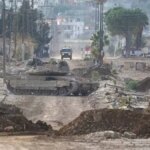
Raising the Israeli flag over Beaufort Castle in southern Lebanon has reopened an old wound within Israel itself, as military leaders who served at the site during the years of occupation came out to warn that the current military achievement may quickly turn into a new version of the “Lebanese quagmire” that ended with the Israeli army’s withdrawal in 2000.
According to interviews conducted by journalist Dodi Fatimer and published by the Israeli newspaper “Maariv”, a number of former military commanders recalled their memories of Al-Shaqif, at a time when the Israeli army returned to control of the site that had long been a symbol of the war in Lebanon.
Beaufort Castle, built since the twelfth century on a hill overlooking the Litani River and the Galilee, is one of the most prominent strategic sites in southern Lebanon. It was used by the Palestine Liberation Organization forces during the 1970s to bomb the northern settlements, before the Israeli army took control of it during the invasion of Lebanon in 1982 in a battle during which 6 Israeli soldiers were killed.
Retired Colonel Dr. Zvi Barkai, one of the participants in the battle to occupy Beaufort in 1982, underestimated the absolute strategic value of the site, considering that the castle had turned over time into a symbol rather than a decisive military target.
He said that controlling Beaufort contributed to removing a direct threat at that time, but he stressed that “whoever believes that the occupation of the Beauforts changed the course of the war strategically is mistaken,” explaining that the importance of the war lay in crossing the Litani River and advancing north toward the other highlands.
Barkai recalled the details of the first battle, noting that he found himself, at the age of 24, leading one of the most important battles after the force commander was wounded and the Golani reconnaissance commander, Goni Harnik, was killed, before he was able to complete the mission and take control of the site.
In a comparison between the past and the present, he saw that Hezbollah today possesses military capabilities superior to those possessed by the Palestinian factions during the 1982 war, but at the same time he pointed out that the Israeli army has become more developed in military and technological terms.
He warned that an Israeli incursion into deep Lebanon without achieving decisive results might lead to the erosion of popular and military support for the operation, considering that any permanent settlement with Hezbollah ultimately requires a political solution, not just a military one.
For his part, retired Colonel Ronen Itzik, who commanded the Shaqif site between 1994 and 1995, recalled his experience at the site during the height of the confrontation with Hezbollah, saying that he would not forget the first days of his arrival at the citadel, when the soldiers were experiencing a state of frustration and a sense of defeat as a result of the success of Hezbollah’s operations against the Israeli forces.
He explained that he worked to reorganize combat positions and raise the level of readiness, considering that this contributed to improving the performance of the forces on the field during that stage.
Although he stressed that the recovery of Shaqif gives him a sense of pride, he acknowledged that a long stay in the region carries serious risks, warning against a return to the model of the war of attrition that Israel faced during its years in southern Lebanon.
Retired Brigadier General Oren Afman, who was the last Israeli commander of the Beaufort sector before the withdrawal in 2000, went further in criticizing the current Israeli political leadership.
He said that Israel finds itself in 2026 facing a reality very similar to what it experienced in 1982, the 1990s, and the beginning of the millennium, considering that the achievements achieved by military units on the ground are being exploited politically without a clear strategic vision.
He added that the Israeli army has achieved important military achievements in recent years, but warned that celebrating Shaqif as a strategic achievement may hide the absence of any clear political plan for after the military operations.
He believed that the pictures published by the Israeli army from the citadel may quickly turn into scenes of a bloody guerrilla war if the military presence continues steadily, stressing that Hezbollah, despite the strikes it has been subjected to, still maintains effective operational capabilities.
Afman concluded by strongly criticizing the Israeli leadership, saying that “the strategic compass is not in Jerusalem but in the White House,” indicating that the final decision regarding the course of the war is no longer in the hands of the Israeli government alone.
This controversy within Israel reflects a remarkable paradox: while the occupation of Shaqif is presented as a new military achievement, leaders who previously participated in its occupation and defense warn that the same road may lead again to the same result with which the first occupation experience in southern Lebanon ended.