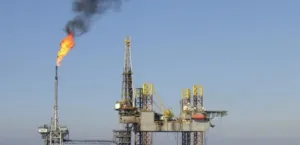
Al-Arabiya newspaper wrote: Global energy markets are witnessing increasing tension due to the expansion of the conflict in the Middle East, which portends a global energy crisis as a result of the disruption of major supply routes and a decline in the production of some refineries in the region.
Reports indicate that a large number of oil tankers have begun to change their course to avoid the Arabian Gulf and head towards the Red Sea, as Saudi Arabia is working to increase the shipment of crude through the port of Yanbu.
This comes in light of the almost complete cessation of shipping traffic through the Strait of Hormuz, through which about a fifth of global oil supplies pass.
Washington eases sanctions on Russian oil directed to India
This halt in shipping traffic led to overcrowding of storage tanks in a number of countries in the region, forcing some refineries to reduce their production capacity.
In global markets, the price of Brent crude rose by about 28% within a week, exceeding the level of $92 per barrel, which is the largest weekly rise since April 2022.
In statements to the Financial Times, Qatari Energy Minister Saad Al-Kaabi expected that all energy exporters in the Gulf region would be forced to stop exports within weeks if the conflict with Iran continues, which could push oil prices to $150 per barrel within two to three weeks if ships and oil tankers cannot pass through the Strait of Hormuz.
Al-Kaabi suggested that everyone who has not yet declared a state of force majeure will do so within the next few days if this situation continues.
He warned that energy prices will rise for everyone, shortages will appear in some products, and a cascading effect may occur that leads to factories stopping supplies.
The Qatari minister pointed out that even if the war ended immediately, Qatar would need weeks or months to return to the normal delivery cycle.
UAE and Kuwait begin reducing oil production
Abu Dhabi National Oil Company “ADNOC” announced that it is managing production levels in offshore fields to meet storage requirements, while Kuwait Petroleum Corporation declared a state of force majeure on production in fields and refineries following Iranian threats to the safety of navigation in the Strait of Hormuz.
Kuwait began reducing production by about 100,000 barrels per day, with an expectation that it will gradually increase according to storage levels.
In return, the UAE uses the Habshan-Fujairah pipeline to bypass the strait and ensure continuous supplies to global markets.
Brent crude recorded weekly gains of approximately 28%, exceeding the level of $92 per barrel, which is the largest weekly jump since April 2022.
A former member of the Economics and Energy Committee in the Saudi Shura Council, Dr. Fahd bin Jumaa, warned of the repercussions of continuing geopolitical tensions on oil supplies and prices, expecting prices to rise to between $100 and $120 per barrel if the war continues.
Bin Jumaa said in an interview with Al Arabiya Business that some Gulf countries may have to declare a state of force majeure on energy exports in the event of continued unrest, noting that Kuwait has already announced this measure, while other countries may resort to the same step to avoid the obligations and costs associated with contracts.
Saudi options
He explained that Saudi Arabia has an alternative option to export oil via the East-West pipeline, whose capacity reaches about 5 million barrels per day, while its natural exports range between 6.5 and 7 million barrels per day, in addition to the presence of oil reserves abroad.
He stated that if the war continues for weeks, a shortage in global supply may appear, while the repercussions may become disastrous for the oil markets if the conflict extends for months, given the market’s sensitivity to any disruptions in supplies.
He pointed out that large quantities of oil pass through the Gulf region, amounting to 14 and 15 million barrels per day through the Strait of Hormuz, and any disruption, even limited, in supplies usually pushes prices to rise significantly.
American actions
Regarding possible American measures, Bin Jumaa said that accompanying tankers or reducing some restrictions may not be enough to calm the markets, because the matter depends on the American companies themselves that seek to achieve the greatest possible returns and oil tankers will not expose themselves to the risks associated with passing through the Strait of Hormuz even if there is protection and it may not be sufficient, so the risks will continue as the war extends.
He said: “With the length of the war, oil prices will rise significantly with a shortage in supply. It is expected that oil prices will range between $100 and $120 per barrel, and then it depends on the severity of the war and the risks.”
Regarding the United States’ possession of an important tool represented by the Strategic Petroleum Reserve, Bin Jumaa said that American production is still high and the stock has increased, noting that the US Strategic Reserve has decreased from about 700 million barrels to approximately 420 million barrels, and if this strategic reserve is used, it may put the future of energy in America at risk.
He pointed out the possibility of stopping US oil exports to achieve a balance between exports and imports, but oil prices will rise sharply.