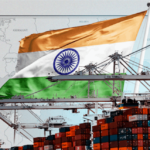
With the pace of reshaping the trade and energy map in the Middle East accelerating, and in the midst of the formation of a new regional order, the “India-Middle East-Europe Corridor (IMEC)” is emerging as a huge project aimed at linking East Asia with Europe, through the Gulf and Jordan and reaching the port of Haifa. While Indian Prime Minister Narendra Modi was signing strategic deals in Tel Aviv, French President Emmanuel Macron’s special envoy, Gerard Mestralier, was exploring in Beirut the possibility of Lebanon joining this path. This coincidence reflects a French diplomatic push to include Beirut in the corridor, while the port of Haifa is solidified as a key link in the initial perceptions of the corridor. Here the real challenge arises: Can Lebanon, despite its geographical location advantage, transform this competitive advantage into an effective logistical structure, enabling it to compete with ports in the eastern Mediterranean?
The talk about Lebanon joining the corridor represents an extension of a broader discussion about Beirut’s repositioning in the regional and international economic system, with a clear French diplomatic push, which appears to be a combination of strategic ambition and a European political maneuver led by France to consolidate this trend, as political economy writer Professor Pierre El-Khoury sees in an interview with “Lebanon 24.” Although President Joseph Aoun and Prime Minister Nawaf Salam expressed Lebanon’s readiness to engage in this initiative during their meeting with Mistrale, economic realism imposes a realistic approach about Lebanon’s ability to move from a marginal station to an influential player, in light of intense regional competition to attract global trade paths.
Infrastructure between capabilities and limitations
Lebanon is distinguished by its strategic geographical location, as it possesses two basic geographical elements: the port of Beirut and the port of Tripoli, which have geographical components that make them natural connecting points between the East and the West. The port of Beirut is characterized by accumulated logistical experience and relatively advanced operational capabilities, despite the damage it sustained, while the port of Tripoli represents strategic depth, due to its proximity to international shipping lines and its northern location close to the Levantine markets. But these advantages, according to Al-Khoury, collide with deep structural challenges, “most notably the absence of a modern railway network linking Lebanese ports to the Arab interior, and weak investment in digital systems and supply chain management, which imposes an urgent need for massive investments to modernize the infrastructure in accordance with international standards. With the inclusion of Haifa Port among the basic concepts of the corridor, the competition becomes more complex. Even if French planning is based on functional distribution that does not require direct normalization, such that Beirut receives all “It has nothing to do with the Arab and Eastern depths to Europe, but the technical superiority and operational readiness of competing ports imposes on Lebanon a race against time.”
The French dimension: logistical influence in the Eastern Mediterranean
Al-Khoury explains the French move as part of a broader strategy to re-establish French influence in the Eastern Mediterranean region, where the role of the CMA CGM company is highlighted, which has strengthened its presence in Lebanon since 2020, and assumed the management of container terminals in Beirut and Tripoli. “This presence is not limited to operational management, but rather establishes an integrated French logistical network, which may constitute an alternative or complementary route to the European Indian myrrh, linking the Lebanese ports directly to the city of Marseille, and from there to the European depths.” Lebanon is becoming a link within the French-Mediterranean network, which enhances the flexibility of the corridor and gives Paris an additional strategic card.”
Educational and economic opportunity
In addition to the geopolitical dimension, the project opens horizons for the education and training sector specialized in logistics and maritime transport, according to Al-Khoury, “Institutions such as the American University of Beirut, the American University of Technology, and the International Maritime Academy have invested over the past years in programs related to logistics sciences and supply chains, in preparation for opportunities similar to those offered today. Hence, Lebanon’s success in positioning within the corridor enhances the demand for local talent, provides job opportunities for young people, and pushes universities to expand Its research and applied programs are in the fields of maritime economics and multimodal transport.”
Geography alone is not enough
At the heart of the French diplomatic proposal, the idea of a corridor based on functional integration stands out as an opportunity to overcome political dilemmas, by focusing on the functional integration that connects Lebanon to the corridor via sea and land lines, going beyond the necessity of direct normalization, according to Al-Khoury, pointing out that the realization of this scenario assumes the existence of Lebanon as a parallel branch that enhances the flexibility of the global corridor, taking advantage of its historical position as a gateway to the East, but on the condition of completing the construction of an integrated logistical system, crystallized through a clearly defined Lebanese-French partnership in the maritime sector.
In conclusion, the opportunity seems ripe for Lebanon to join the Indo-European corridor, but it is conditional on a real reform will, qualitative investments, and the ability to transform geography into added value. Without this, Lebanon will remain a candidate to be a marginal transit station, rather than becoming a focal point in the new global trade network.