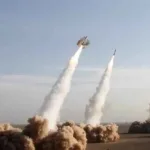
Ballistic missiles are considered the pinnacle of military engineering. They are not just weapons, but rather a physical miracle that combines the laws of space mechanics with strategic complexity. The movement of these missiles depends on a precise trajectory that combines propulsion and ultimate control, making them a tool with great geopolitical influence.
Stages of physical flight:
The flight of a ballistic missile consists of three basic stages, starting with the “propulsion stage,” where the missile engine runs for a few seconds or minutes to give the missile the speed and altitude necessary to overcome Earth’s gravity.
This is followed by the “free flight phase”, which is the longest and most complex phase, during which the missile emerges from the atmosphere and follows a curved (ballistic) path determined by the laws of physics and gravity, reaching speeds that exceed the speed of sound many times.
Finally, comes the “entry phase,” where the warhead re-enters the atmosphere at high speed, requiring an advanced design to withstand the heat generated by friction with the atmosphere and accurately reach the target.
Engineering and strategy:
From an engineering standpoint, the biggest challenge is achieving a balance between weight, fuel type, and guidance system that ensures hitting the target with high accuracy using inertial or satellite navigation systems.
As for the strategic aspect, the ballistic missile represents the cornerstone of “strategic deterrence,” as its ability to travel thousands of kilometers in record time makes it difficult for traditional air defense systems to intercept it, which imposes complex global power balances.
The future of deterrence:
With rapid technological progress, ballistic engineering has transformed from being a mere “guided missile” to systems capable of maneuvering and changing its course in the final stages, reshaping the concepts of missile defense globally.
This journey, which begins at the launch pad and ends at the target, is in essence an embodiment of the perpetual conflict between advanced destructive capacity and the protection systems that seek to neutralize it.