The Chinese technology company Xiaomi has announced the use of “human robots” in the assembly operations of its electric cars, according to what the company’s CEO, Lei Jun, announced on his WeChat account.
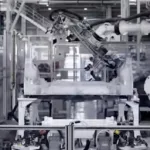
Sources within the company stated that the human robot worked on installing self-tapping screws in the mold casting workshop for Xiaomi electric cars, and achieved a “success rate of 90.2%” within three continuous working hours, and completed the task in “76 seconds,” which is in line with the fastest cycle time required in the production line.
Xiaomi emphasized that the use of these robots represents an important step towards achieving its vision of “widespread application in manufacturing scenarios in the automotive industry.” She added that experiments are still ongoing in other production plants, and more updates will be announced at a later time.
Analyze the task and technology used
The task involves the robot accurately picking up self-tapping screws from the automated feeder and placing them on the mounting bases, then coordinating with conveyor and skid belts to complete the connection of the floor components after the integral casting.
The company explained that the biggest challenge lies in “achieving precise alignment and correct handling of the screws,” due to the complex screw design, the influence of magnetic forces, and the flexibility of the grip position, which increases the difficulty of assembly.
Xiaomi relied on a data-driven “joint training framework,” using an internal “Vision-Language-Action (VLA)” model containing 4.7 billion parameters, with reinforcement learning, which reduces reliance on manual data and allows the robot to quickly adapt and learn from the surrounding environment.
The robot uses a combination of “conventional optimization-based control” with reinforcement learning, enabling it to control full body movement and response in real time, while maintaining balance even in extreme conditions.
Five-year plan and future expansion
Li Jun revealed that the company aims over the next five years to “deploy humanoid robots on a large scale in its factories,” and also plans to expand their use in “smart homes,” which could open a new market estimated at trillions of yuan.
This step comes in parallel with other companies such as BMW and Tesla, which have also begun experimenting with human robots in their factories, which reflects the transformation of these robots from mere experimental models to practical roles on production lines.