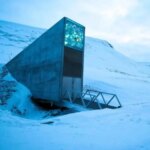
The Svalbard Global Seed Vault is a huge reserve, containing copies of millions of seeds from around the world. This project aims to protect agriculture from the risk of extinction in the event of natural disasters, devastating wars, or severe climate crises.
The vault is known as the “Doomsday Vault” and is located deep in a mountain located on the remote island of Spitsbergen, within the Norwegian archipelago of Svalbard. Operations at this cellar began in 2008 under the management of the Norwegian Ministry of Agriculture and Food. The warehouse is located more than 100 meters underground, although its entrance is clearly visible on the surface. This depth ensures that the seeds are frozen and remain germinable even in the event of a complete power outage.
Seeds are kept in three-layer metal containers placed inside boxes arranged on shelves. A constant temperature of -18°C is maintained, as well as very low humidity levels, to ensure that the seeds remain viable for very long periods of time. Furthermore, permanent permafrost and thick rock provide additional protection. The site is classified as geologically safe and immune to marine flooding.
The vault has recently seen a major addition to its collection, with more than 7,800 new seed varieties deposited. These additions include staple beans from Africa, olive varieties from Spain, and ancient crops from Guatemala. Thus, the total number of stored seeds reached 1,386,102 seeds.
The new donations included seeds from two countries that had not previously participated in this project: Guatemala and Niger. Guatemala sent two types of teosinte, the wild ancestor of maize. While Niger sent 204 varieties of basic crops, including sorghum, cowpea and peanuts.
In a related context, donations to the Olive Gene Bank of the University of Cordoba included wild olive seeds from Spain, in addition to the 50 most important varieties cultivated on a global scale. “Local olive varieties are threatened by the aging of trees and the decline in profitability of traditional olive groves,” explained Dr. Concepcion Muñoz Diez of the university.
Dr. Stefan Schmitz, Executive Director of the Crop Trust, emphasized that “storing seeds in Svalbard is one of the easiest and most important steps the world can take to protect the foundation of agriculture.”
The vault has a capacity to store 500 seeds from 4.5 million varieties, equivalent to 2.5 billion seeds. It aims to serve as the ultimate black box for global gene banks. Depositors retain ownership of their seeds, ensuring that these banks are able to replenish their pools in the event of any disaster.