The Israeli raids on the Bekaa region have put Lebanon back on the brink of regional conflict, reflecting the possible scenario of the country slipping back into a cycle of violence if negotiations between Washington and Tehran fail, a failure that could turn into direct confrontations on the ground. On the other hand, achieving progress in the negotiations may ease tensions. In both cases, it seems that stability is no longer an internal decision, and the Lebanese have become mere observers of the accumulated political and economic developments awaiting possible solutions and treatments at the government’s table.
At the same time, efforts in the three presidential palaces focused on strengthening Lebanon’s ability to withstand various challenges. President Joseph Aoun renewed his commitment to holding parliamentary elections, and praised the steadfastness of the people of the south who “gave the entire country the most powerful and powerful messages of steadfastness, patriotism, and rootedness in the land.” While receiving a delegation from Rmeish, Aoun confirmed that “the army is expanding its deployment, opening its hands to the people of the region who wish to volunteer in it and in all security services.”
As for Prime Minister Nawaf Salam, who is leading a financial initiative entitled “Improving revenues and combating tax and customs evasion without discretion,” he discussed regional developments and the army support conference with US Ambassador Michel Issa.
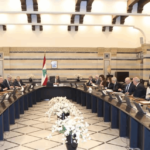
The Cabinet session also stressed the necessity of linking any treatment of public sector demands or support for specific sectors to a comprehensive vision that maintains the stability of public finances and avoids harming the exchange rate.
In this context, Decree No. 2591 was issued, calling on the House of Representatives to hold an extraordinary session at the beginning of March for a period of two weeks, with the signature of the Presidents of the Republic and the Government. This decree goes beyond its constitutional importance to emphasize the opportunity for the Parliament to approve draft financial and structural laws included or that will be referred to it.
On the social level, for the first time, the Council of Ministers agreed to integrate people with disabilities and put an end to their marginalization through the National Strategy for Persons with Disabilities prepared by the Ministry of Social Affairs.
In a television interview on the occasion of the one-year anniversary of his assuming the presidency of the government, Salam stated, “We are in need of Iran’s support and hope for the availability of a minimum level of rationality and patriotism.”
Salam gave a calm presentation of his achievements, pointing to a “reform accumulation” that begins with controlling public finances, goes through rebuilding trust with international partners, and does not end with consolidating the independence of the judiciary and modernizing the administration.
The Prime Minister stressed the ability to hold parliamentary elections without the 16th district, and spoke about implementing the second phase of the arms control plan within 4 months if appropriate conditions exist, declaring that it is the first time that the Lebanese state has regained full control over the south, with the exception of the points occupied by Israel.