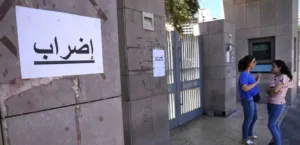
Yesterday’s street action was not a simple objection to the government’s decisions to raise the price of gasoline and increase the value-added tax, but rather it was an explosion of popular anger that had been accumulated for years. The two decisions directly affected the daily lives of the Lebanese, in light of a difficult economic situation that is witnessing a decline in incomes and an erosion in purchasing power.
On the other hand, despite calls for demonstrations to protest the rise in gasoline prices and the tax increase, the evening movement in Beirut was modest and had limited impact, as participation was weak compared to the morning movements, which witnessed a greater turnout.
In Riad Solh Square, the scene was limited to a few dozen protesters without escalatory steps being taken, while scattered movements were recorded in the south, reflecting individual protests rather than organized movement.
Political sources told Al-Jumhuriya: The interpretation of this movement must be separate from the traditional description of the protests. The issue is no longer merely an objection to a specific financial policy, but rather reflects the shaking of confidence in the state’s management of the crisis, because the rise in fuel prices affects the prices of goods and services, and the increase in TVA affects daily consumption, doubling the impact on the middle and poor groups. Therefore, the street movement sends three clear messages: Refusing to pass the cost on to the people alone, because there is a feeling that the authority is resorting to the citizen’s pocket instead of addressing waste and corruption. The mood has shifted from objection to accountability, because the street is no longer just demanding corrective measures, but is waving the election card as a tool of punishment. Possibility of politicization, as any social movement in Lebanon can interfere with political and partisan calculations, whether by supporting it, investing in it, or containing it. The same sources confirmed that the government’s fate will depend on its ability to manage the crisis politically, not just financially. If it contents itself with a technical defense of its decisions under the title of “necessity” or “conditions of international institutions,” it risks widening the gap between it and public opinion, which will put it in front of three scenarios: rapid containment of the popular movement by offering compensatory packages or partial modification of decisions to absorb anger. Intransigence and betting on time, which may lead to the protests escalating and expanding in scope. Political vibration if popular pressure turns into a division within the components of the government itself, especially if some forces feel that the electoral cost has become high.
The sources pointed out: “In the Lebanese case, governments often do not fall because of the street alone, but rather when the street meets an internal political rift. If the participating forces remain cohesive, the government may survive, albeit at a heavy popular price. However, if it breaks, the fate of the government will become a subject of discussion.”
The sources said that the increasing talk about the possibility of postponing the elections or extending the Parliament is linked to the climate of political anxiety, as some forces may see the postponement as a way to avoid possible losses in light of a dissatisfied popular mood. But the extension option also carries its risks, as it may be understood as circumventing the popular will, which exacerbates tensions instead of calming them. She added: “If the elections are held on time, the living crisis will be the most prominent headline of the electoral campaigns. The opposition forces will base their rhetoric on holding the government responsible for the collapse and taxes, while the forces of power will seek to justify their options as the ‘least expensive’ in light of a pressing financial reality. Therefore, the current equation has become as follows: the street is pressuring, the government is maneuvering, and the political forces are calculating their profits and losses. In democratic systems, the ballot box constitutes a safety valve to channel popular anger. When an option is presented, Postponing or extending, the message that the citizen receives may be completely opposite. Thus, it can be said that the current protests are not only about the price of a can of gasoline or the TVA rate, but rather about the model for managing the crisis as a whole, and if they are not met with serious reform steps that restore some confidence, they may turn into a political turning point, either by adjusting the balance of power in the elections, or by bringing the country into a constitutional and political debate over the legitimacy of the extension. In addition, diplomatic sources told Al-Jumhuriya that Monday’s session, which for the United States of America was a station awaited for weeks to launch the second phase of the plan to disarm, limit or contain weapons, suddenly turned into the title of tax demands, and this matter led to placing the arms file in second place.
These sources asked: “Is what happened, in terms of igniting the street and threatening to blow up the government, a pre-planned scenario, the details of which have begun to emerge, especially in the budget session, as a carefully thought-out way out for the confrontation over the weapons issue?” The government is on the issue of weapons, while it is faltering under the pressure of the street and the demand movement.”
Al-Liwaa wrote: Yesterday, the Council of Ministers’ decision to raise the price of gasoline by 300,000 liras per plate, increase the value-added tax from 11 to 12%, and raise container fees at the port between 40 and 80 dollars, depending on the size of the container, to meet the demands of employees and military personnel, witnessed ministerial and parliamentary objections. Especially since fuel prices rose significantly yesterday, so that the price of gasoline rose by 361,000 liras, diesel by 22,000, and gas by 13,000. To cover the decision of the Council of Ministers to give employees 6 additional salaries with all their supplements for the military based on the value that was decided in 2019. The value of the increase in salaries and benefits amounts to 800 million dollars annually.
According to some economic experts, raising all these fees would reflect an increase in the prices of transportation, electricity subscriptions for private generators, communications, medicines, and other services such as “delivery” and maintenance, in addition to restaurant prices, which inevitably means an increase in the prices of necessary goods, food, and consumables, under the pretext of the high cost of transportation and electricity, which exacerbates the burden on a large percentage of citizens, exceeding 90 percent. Prices will also rise by 3 percent and inflation by 0.06 percent, reaching 18 percent or more.
Constitutional expert Saeed Malik confirmed in a statement to Al-Liwaa that the decision issued by the government the day before yesterday includes two parts. The first relates to adding 300,000 liras to gasoline, as this is its right in accordance with the provisions of Article 55 of the Budget Law, which granted the government the right to legislate customs. As for raising the value-added tax, this needs a law. The government has sent a draft law in this regard, and the House of Representatives is supposed to consider this draft and either approve it or reject it.
In response to a question about the possibility of the government reversing its decision to add 300,000 liras to the gasoline tank,
Possible said: This is possible, and when the government deems it appropriate to reconsider its decision and reverse it.
Positions
Prime Minister Nawaf Salam said to ease the reality and calm the street. He said during his tour yesterday in Tripoli: “The most important thing is that the public sector deserves these increases, which are late increases, and the military deserves them. As for the university, we will free up more of its professors who have been under contract for a long time and must be free. As for the public sector, we are looking forward to ensuring that its workers get the rights, at least today, with an acceptable salary. The cost for these matters is estimated at about 800 million dollars. Where will we secure them? We need to pay the military tomorrow. Returning to the decision, we will find that we have decided to improve Collecting taxes and improving customs collection, which has improved by 150%… We will also review all sea and river properties to collect all arrears. This is the basis.”
He considered that the increase in value-added tax “does not affect the majority of those with limited income and the popular classes because education is exempt from this tax, health is exempt, and many consumer items are also exempt. Above all, we cannot accept the statement that we have made increases that affect the popular classes.” He continued: “Of course, there are those who objected to the increase in gasoline. We were forced to do so. Do you think, for example, that we really wanted that? It was not an easy decision, and at the same time we canceled increases in diesel fuel, because this matter relates to people who benefit from this substance in the barrenlands in this season, the cold season, and it also relates to industrialists. We do not want to cause any harm.”
In turn, Finance Minister Yassin Jaber justified the background of the decision, saying: “We have reached an escalating crisis and a paralyzed public sector that is suffering, and a decision had to be made. There was negotiation with the military and a meeting in the Ministry of Defense, and the move was to approve the increase, and those gathered understood that approving it without revenues would expose the country to a crisis.” He pointed out that “giving the increase without income exposes the country to a crisis, and this was the IMF’s recommendation, and we are very keen to maintain the financial balance.” He explained, “The treasury cannot pay $800 million, and the decisions that have been taken do not cover the full amount, but we will strive to secure it. More than 50% of the budget today is salaries, and steps had to be taken to secure funds.” He explained that “public sector employees receive gasoline cans and the state pays for them from the treasury, and that 30% of imported goods are exempt from value added.” He pointed out that “it was necessary to take steps in order to achieve balance and cover some demands, and government decisions will secure $620 million.”
Head of the Finance and Budget Committee, MP Ibrahim Kanaan, said after his visit to Parliament Speaker Nabih Berri, “The rights are right. Our people and our people have waited a long time for relief. Is it useful to impose new taxes? Does that secure the public interest? What is required is to be patient and secure exceptional measures for the public sector, but according to a comprehensive study and complete and comprehensive reform.” He said, “What the government promised us in the House of Representatives was different. It pledged increases for the military and the public sector that ensure continuity and do not put the employee, the military, and the professor in front of the people, and do not impose a large cost on the treasury.”