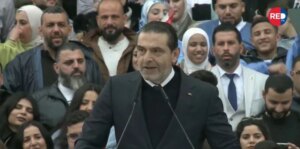
Representative Faisal Al-Sayegh, a member of the “Democratic Gathering” bloc, stated in an interview with the Kuwaiti newspaper “Al-Anbaa” that the Lebanese army enjoys widespread appreciation at the Arab and international levels. He pointed out that the Arab countries and the international community praised his achievements in the southern Litani region, the latest of which was the American mention of the discovery of a new tunnel belonging to Hezbollah.
Al-Sayegh believed that this achievement “will build upon the foundations and pillars of success for the army support conference expected to be held next March 5 in the French capital, Paris,” stressing that the world has become convinced that the Lebanese government’s decision to confine arms to the state “cannot be implemented overnight, and without strengthening the army’s combat, logistical, technological, and financial capabilities.”
He explained, “The great success achieved by the visit of Army Commander General Rudolph Heikal to the United States formed one of the basic pillars of the desired success of the Army Support Conference.”
Al-Sayegh stated that the French and Saudi efforts to expand international participation in the conference, in addition to the United States’ confirmation of its regular aid to the Lebanese army at a value of $90 million annually, in addition to Arab interest, especially the Gulf, in the role of the military institution, are all indicators that indicate that the international conference in support of the Lebanese army “will end with a success beyond expectations.”
He stated that this conviction comes from the international community’s awareness that the achievements required of the Lebanese army, most notably the exclusivity of weapons in the hands of the state, “exceed its current capabilities and can only be achieved by strengthening its capabilities at all levels.”
In the same context, Al-Sayegh explained that linking international reconstruction aid to the withdrawal of weapons and confining them to the state does not conflict with the international conviction that the capabilities of the Lebanese army must be strengthened, as it is the tool that will implement the second phase of the plan to withdraw weapons in the Mesopotamian region, that is, north of the Litani and south of Awali, in addition to the third and final phase that aims to complete its spread and withdraw weapons across all Lebanese territory, in addition to its role in combating armed groups and securing the borders with Israel and Syria.
In response to a question, Al-Sayegh stressed that “there is absolutely no fear that Hezbollah’s stubbornness in refusing to hand over its weapons outside the south of the Litani will slide into internal confrontations,” considering that the party has repeatedly announced its rejection of this option, and that the bulk of its rhetoric “is directed more at its environment than at the political authority.”
He pointed out that the next stage will witness the Lebanese army implementing the second stage of its plan north of the Litani, just as it implemented the first stage south of the river. He explained that Hezbollah, as a partner in the government and possessing a large bloc in the House of Representatives, has become aware that its weapons “have become, due to the decline of the phase of Iranian intervention in the Arab region, out of service,” and that reversing the government’s decision to exclusivity of weapons is “impossible.”
Al-Sayegh concluded his speech by saying: “We hope that Hezbollah, if the negotiations between the Americans and the Iranians falter and the previously rejected war breaks out between them, will stand behind the Covenant and the government, and not slide into a new adventure under the title of supporting Iran, because the price will not be lower than what its environment and all the Lebanese without exception paid as a result of its support of Gaza.”