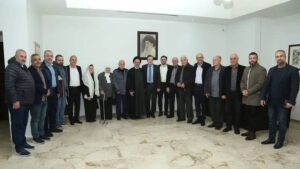
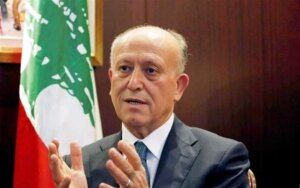
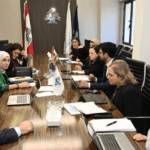
Under the patronage of Hezbollah Secretary General Sheikh Naim Qassem, and in the presence of a crowd of former MPs and ministers, in addition to municipal, religious, union and hospital figures, representatives of the security services and those interested in health affairs, Public Health Minister Rakan Nasser al-Din opened the “Lebanon Medical Center” at the event.
The opening ceremony began with the recitation of verses from the Holy Qur’an, then the Lebanese national anthem was played, followed by speeches delivered on this occasion, including watching a video report highlighting the center’s departments and the various services it provides, including robotic surgery.
In his speech, the Center’s General Director, Hassan Allik, expressed his welcome to the attendees, stressing that “reviving oneself is an act of resistance,” and that the medical profession “when practiced with conscience turns into a front for dignity,” stressing that the goal of establishing the Center is to be “a scientific, humanitarian, and national edifice” that effectively contributes to developing the health sector, raising the level of the Lebanese medical staff, and providing its services “to all Lebanese.”
For his part, the Minister of Public Health stated that the opening of a “new, modern and advanced hospital” is considered a “qualitative addition” to the hospital sector in Lebanon, indicating that these words are a “testimony of truth” after inspecting the center’s departments and reviewing its equipment. He pointed out that the center provides advanced services in the fields of radiology, laboratories, surgical, hospital, pharmaceutical and research departments, considering it a “fundamental pillar” in the process of treating cancer in Lebanon.
Nasser al-Din addressed what he described as the “tragedy of Tripoli” following the recent events, announcing a special initiative for residents of buildings on the verge of collapse, which is based on providing 100% comprehensive health coverage in government hospitals, at the expense of the Ministry of Health, stressing that this comes within the framework of the responsibility to support the most needy groups, stressing that “our people are one, our people are one, and the suffering is one.”
The Minister reviewed the Ministry’s most important achievements during the year, noting “tangible progress” in two main axes: medicine and hospitalization. In the field of hospitalization, he explained that the volume of spending increased from $38 million in 2024 to more than $150 million in 2025 to cover the costs of treating citizens in government and private hospitals at the expense of the Ministry of Health, coinciding with a “paradigm shift” in the field of financial auditing and accelerating payment procedures, which enhances trust between the Ministry, hospitals, and doctors, and reflects positively on the patient.
He also pointed out the addition of specific operations within the approved operations model, and providing support to government hospitals through funded projects worth more than $100 million, pointing out that more than 70% of the equipment has become available to serve citizens inside government hospitals.
Regarding medicine, he talked about expanding therapeutic protocols, which has had a positive impact on patients with cancer and incurable diseases, and about increasing spending to 103 million dollars in 2025 compared to 32 million in 2024, in addition to taking steps to combat smuggling and counterfeiting through inspection, security coordination, activating tracking mechanisms, approving the implementing decree of the National Medicines Agency, and preparing for the opening of specialized laboratories.
For his part, Sheikh Naim Qassem confirmed that the “Lebanon Medical Center” is a university hospital that includes large and specialized departments, and it comes within the framework of the path adopted by “Hezbollah” to provide health care in various regions “to meet the needs of the people and society.” He stressed that work in the field of health and social services is carried out “in the name of duty towards the people” and not for any other considerations, stressing that the center is open to all Lebanese.
Qasim touched on the advantages that the center enjoys, noting the presence of advanced specializations in oncology treatment, nuclear medicine, bone marrow transplantation, and robotic surgeries, considering that it reduces financial burdens by offering prices that are “approximate to the cost,” and praised the medical, nursing, and administrative staff working in the center.
In the political aspect of his speech, Qassem saw that the “central problem” facing Lebanon is the continuation of Israeli attacks, calling for solidarity and unity, and at the same time appreciating the visit of Prime Minister Nawaf Salam to the south, describing it as positive. He also called on the government to pay special attention to Tripoli and take quick steps to address the issue of dilapidated buildings and secure shelter allowance for those affected.
The opening of the “Lebanon Medical Center” comes in light of increasing pressures on the health sector in Lebanon as a result of the economic crises and the repercussions of the Israeli attacks, and in the midst of official efforts to strengthen the ability of government and private hospitals to continue.
In recent days, the issue of collapsing buildings in Tripoli has returned to the spotlight after painful incidents occurred, which necessitated government action and emergency measures for evacuation and shelter, coinciding with the Ministry of Health announcing steps to provide care for those affected and linking them to primary care centers.