October 3, 2026

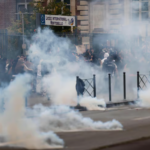
The protests of high school students in France have expanded from demands related to the shortage of teachers, poor infrastructure, and classroom overcrowding to a broad political and security confrontation. According to a report by news agencies published by the Israeli newspaper Yedioth Ahronoth, the protests resulted in the arrest of more than 400 people, most of them minors, and the injury of dozens during confrontations that witnessed the use of tear gas and the setting of fires.
The protests erupted last week, accompanied by the closing of the entrances to a number of schools, before merging on Tuesday with a broader strike in the public sector. These developments came at a very sensitive time, ahead of the government’s presentation of the 2027 budget on October 1, which includes plans to reduce spending by 54 billion euros to ease pressures on public finances, with public debt reaching 119% of gross domestic product by the end of the second quarter of 2026.
Several cities witnessed manifestations of violence. In the suburb of Saint-Denis, north of Paris, students gathered near fires set at school gates, while demonstrators threw projectiles at security forces in Lyon and Lille. Education Minister Edouard Joffre confirmed that 76 people had been injured since the start of the protests, while Interior Minister Laurent Nunez indicated that about 440 people were arrested on Tuesday alone, and 7 cases of throwing hydrochloric acid at the police were recorded. Action organizers reported that about 400 secondary schools were affected, out of approximately 3,700 schools nationwide.
The 17-year-old student, Vadella, explained to Reuters that the conditions inside the schools are very bad, infested with cockroaches and rats, and temperatures range from unbearable heat to sub-zero cold. Meanwhile, our colleague Gamza pointed out the lack of equal treatment between schools in working-class suburbs and schools in Paris and rural areas.
The protests gained political dimensions after receiving public support from figures in the “France Intrepid” (LFI) party led by Jean-Luc Mélenchon, one of the most prominent candidates in the upcoming presidential elections. This engagement sparked sharp political criticism. Valérie Pécresse, the conservative president of the Ile-de-France region, accused the party of stoking student anger, while the party’s mayor, Bali Bagayoko, defended his statements regarding the violence, stressing that they were taken out of context.
In the official context, French President Emmanuel Macron condemned the acts of violence, stressing that anger does not justify them and that political leaders may not grant them legitimacy, stressing that schools were created to remain open to impart knowledge, not to close them and start fires.
These movements coincided with a strike by public sector employees, with the participation rate reaching less than 10% among state employees, and just over 11% among teachers and school workers. Demonstrators in Paris, Marseille, and Nantes raised slogans demanding higher wages, freezing prices, and providing additional resources to the public sector instead of financing the “war budget,” in parallel with a separate demonstration of thousands of firefighters to demand improved resources and working conditions.
This comes in light of the limited amendments to the public sector employee salary index since 2017, which were limited to two increases of 3.5% in 2022 and 1.5% in 2023. Thus, the education crisis overlaps with public sector protests and government financial pressures, to constitute a decisive political and social test for the French authority months before the presidential elections.